
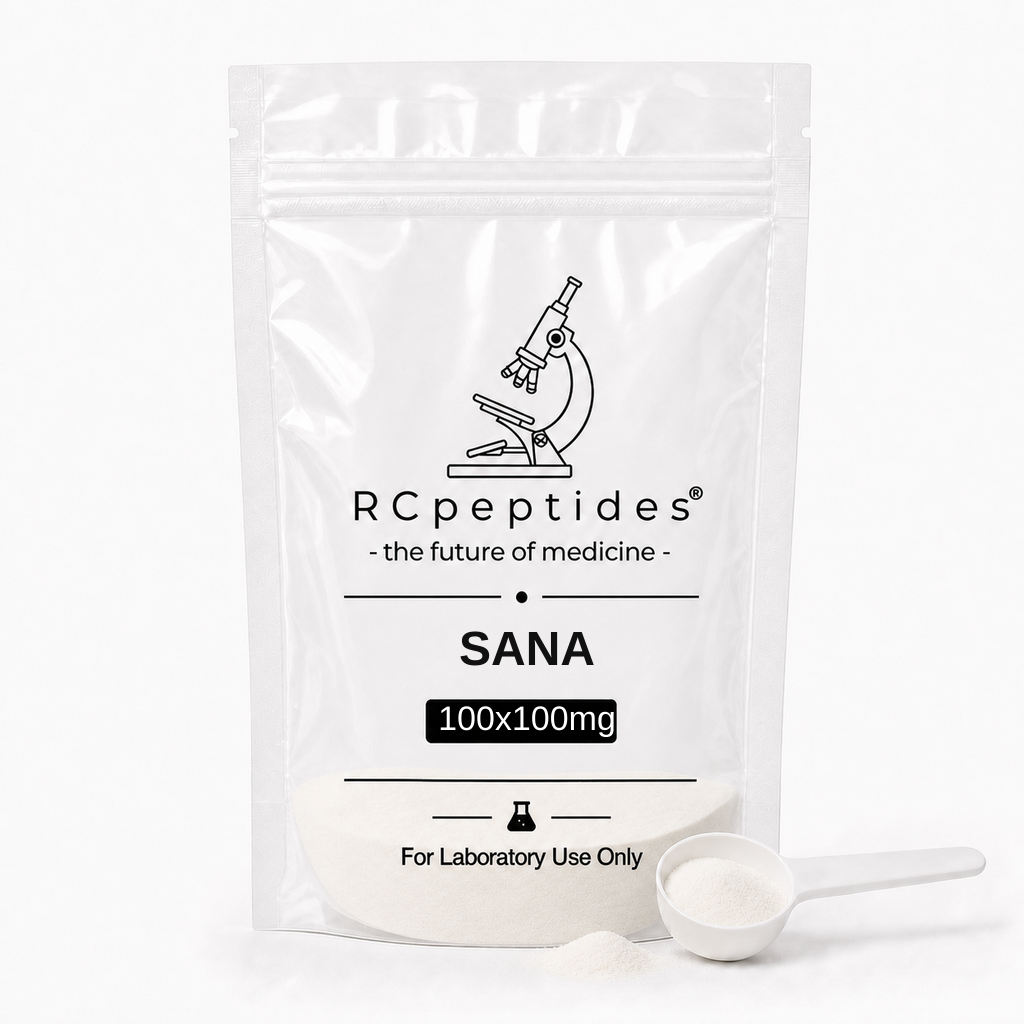
SANA 100x100mg
€150.00
SANA (MVD1): Benefits, Mechanism, Safety & Research ReviewSANA, also known as MVD1 or 5-(2-nitroethenyl)salicylic acid, is an experimental nitroalkene derivative of salicylate being developed as a potential treatment for obesity, insulin resistance and metabolic dysfunction. Its CAS number is 42571-07-3, molecular
NOT FOR HUMAN CONSUMPTION
SANA (MVD1): Benefits, Mechanism, Safety & Research Review
SANA, also known as MVD1 or 5-(2-nitroethenyl)salicylic acid, is an experimental nitroalkene derivative of salicylate being developed as a potential treatment for obesity, insulin resistance and metabolic dysfunction. Its CAS number is 42571-07-3, molecular formula C₉H₇NO₅, and molecular weight approximately 209.16 g/mol.
Unlike GLP-1 receptor agonists, SANA does not appear to promote weight loss primarily through appetite suppression. Instead, preclinical work suggests that it increases energy expenditure in adipose tissue through creatine-dependent thermogenesis.
A 2025 Nature Metabolism study reported extensive preclinical characterization together with a randomized, double-blind, placebo-controlled Phase 1A/B first-in-human trial.
Potential Benefits of SANA (MVD1)
|
Benefit |
Key take-away |
|---|---|
|
1 Weight loss |
SANA produced substantial weight-loss effects in diet-induced obese mice and preliminary weight reduction during short-term human Phase 1 testing. |
|
2 Increased energy expenditure |
Activates creatine-dependent thermogenesis in adipose tissue, increasing energy consumption rather than primarily reducing food intake. |
|
3 Insulin sensitivity |
Preclinical studies showed reduced insulin resistance, while the highest-dose human cohort showed improvement in HOMA-IR after 15 days. |
|
4 Glucose control |
Improved basal glycaemia and glucose tolerance in obese animal models; preliminary glucose-management improvements were also observed in humans. |
|
5 Liver steatosis |
Reduced or prevented obesity-associated hepatic steatosis in rodent models. |
|
6 Adipose thermogenesis |
Stimulates mitochondrial respiration and heat production in both brown and white adipose tissue. |
|
7 UCP1-independent thermogenesis |
Thermogenic effects persisted independently of UCP1, differentiating SANA from classical brown-fat thermogenic pathways. |
|
8 Appetite-independent weight loss |
Weight reduction occurred in obese mice without a corresponding reduction in cumulative food intake. |
|
9 Metabolic syndrome potential |
Combined effects on obesity, insulin resistance, triglycerides and liver fat make SANA a potential candidate for broader metabolic disease treatment. |
2. SANA Mechanism of Action
2.1 Creatine-Dependent Thermogenesis
The most distinctive proposed mechanism of SANA is activation of creatine-dependent energy expenditure in adipose tissue.
Creatine is normally cycled between:
-
creatine,
-
phosphocreatine,
-
ATP-dependent phosphorylation reactions.
Under certain conditions, this cycling becomes metabolically inefficient and consumes ATP without generating useful mechanical work.
The lost energy is released as heat.
This process is often described as the futile creatine cycle or creatine-dependent thermogenesis.
SANA appears to stimulate this pathway in adipocytes, increasing mitochondrial respiration and total energy expenditure.
2.2 Proposed Downstream Biology
|
Pathway |
Functional outcome |
Context |
|---|---|---|
|
Creatine cycling ↑ |
ATP consumption / heat generation |
Adipose tissue |
|
Mitochondrial respiration ↑ |
Increased energy expenditure |
Brown + white adipocytes |
|
Thermogenesis ↑ |
Greater metabolic energy loss |
Obesity |
|
Insulin sensitivity ↑ |
Improved glucose handling |
Metabolic dysfunction |
|
Hepatic fat ↓ |
Reduced steatosis |
Obesity-associated liver disease |
A simplified model is:
SANA → adipose creatine metabolism ↑ → mitochondrial energy expenditure ↑ → thermogenesis ↑ → increased caloric expenditure
3. UCP1-Independent Thermogenesis
One of the most interesting findings is that SANA does not appear to depend on UCP1.
UCP1 is the classical mitochondrial uncoupling protein responsible for much of brown-fat thermogenesis.
However, the metabolic effects of SANA persisted:
-
under thermoneutral conditions,
-
without normal UCP1-dependent thermogenesis,
-
and without direct mitochondrial uncoupling.
Instead, its effects were strongly dependent on creatine metabolism.
Experimental creatine depletion markedly reduced SANA-mediated thermogenesis, and disruption of mitochondrial creatine kinase signaling impaired the thermogenic response.
This suggests SANA may represent a mechanistically distinct class of anti-obesity compounds.
4. AMPK and Metabolic Signaling
Salicylates can influence AMP-activated protein kinase (AMPK) and inflammatory signaling.
SANA retains several signaling properties associated with nitroalkene/salicylate compounds.
However, the major weight-loss and thermogenic effects observed in the 2025 study were reported to occur independently of AMPK activity.
This is important because SANA’s metabolic effect appears to extend beyond simply acting as a more potent salicylate derivative.
5. Preclinical Evidence
5.1 Diet-Induced Obesity
SANA showed strong effects in rodent models of diet-induced obesity.
Reported outcomes included:
-
reduced body weight,
-
prevention of excessive weight gain,
-
improved glucose tolerance,
-
decreased basal glycaemia,
-
reduced insulin resistance,
-
reduced circulating free fatty acids,
-
reduced hepatic steatosis,
-
improved metabolic markers.
Importantly, weight loss occurred without decreased cumulative food intake, supporting increased energy expenditure as a central mechanism.
5.2 Established Obesity
SANA was not limited to obesity prevention.
When administered after obesity had already developed, treated animals:
-
lost weight,
-
improved glucose tolerance,
-
showed reduced liver fat,
-
and displayed improved metabolic parameters.
In experimental comparisons, SANA also produced stronger glycaemic effects than equivalent salicylate treatment in the studied mouse models.
6. Human Phase 1A/B Trial
The first-in-human trial was a randomized, double-blind, placebo-controlled Phase 1A/B study.
It included two main stages.
Single Ascending Dose
Healthy lean volunteers received single doses of approximately:
200–800 mg
Multiple Ascending Dose
Participants with overweight or obesity received approximately:
200–400 mg per day for 15 days
The primary objective was:
-
safety
-
tolerability
Secondary and exploratory endpoints included:
-
pharmacokinetics,
-
body weight,
-
glucose metabolism,
-
metabolic biomarkers.
7. Human Weight-Loss Findings
Although the Phase 1A/B trial was not primarily designed as an efficacy trial, preliminary metabolic effects were observed.
At the highest repeated dose, participants showed:
-
a decrease in body weight,
-
improvement in glucose management,
-
improvement in HOMA-IR.
These changes occurred over approximately 15 days.
This provides an early human proof-of-concept signal, but the trial was small and short.
Therefore, SANA cannot yet be considered a proven anti-obesity treatment based on these findings alone.
8. SANA Pharmacokinetics
Human pharmacokinetics were assessed during the Phase 1A/B study, although detailed clinical PK characterization remains substantially less mature than for approved obesity drugs.
Preclinical mouse studies showed:
-
rapid absorption after oral administration,
-
approximately 0.5-hour Tmax after a high oral dose,
-
no detectable circulating SANA after 24 hours in that experiment.
Biodistribution studies suggested an enterohepatic component, with elimination involving both:
-
kidneys,
-
intestine.
Human half-life and optimal therapeutic exposure still require further characterization in larger clinical studies.
9. SANA Safety and Tolerability
Human Safety
In the first Phase 1A/B trial, SANA showed an overall favorable short-term safety and tolerability profile.
Repeated administration of up to approximately 400 mg/day for 15 days was tolerated in the studied participants.
Preclinical Safety
Longer-duration treatment in mice also did not show obvious evidence of:
-
renal toxicity,
-
hepatic toxicity
under the conditions examined.
However, these data should not be interpreted as proving long-term human safety.
10. Important Safety Limitations
SANA remains an experimental investigational compound.
Important unknowns include:
-
long-term human safety,
-
cardiovascular effects during chronic thermogenesis,
-
long-term renal effects,
-
long-term hepatic effects,
-
reproductive toxicity,
-
pregnancy safety,
-
drug interactions,
-
effects in people with cardiovascular disease,
-
effects during prolonged caloric restriction,
-
optimal therapeutic exposure.
Commercial research-chemical material should also not be assumed equivalent to pharmaceutical-grade MVD1 used in controlled clinical research.
11. SANA vs GLP-1 Weight-Loss Drugs
SANA and GLP-1 receptor agonists appear to target obesity through fundamentally different mechanisms.
|
Feature |
SANA / MVD1 |
GLP-1 agonists |
|---|---|---|
|
Main mechanism |
Energy expenditure ↑ |
Appetite ↓ / satiety ↑ |
|
Primary tissue |
Adipose metabolism |
CNS + gastrointestinal system |
|
Thermogenesis |
Creatine-dependent ↑ |
Not primary mechanism |
|
Appetite suppression |
Not primary |
Strong |
|
Human evidence |
Phase 1A/B |
Extensive Phase 3 / clinical use |
|
Long-term efficacy |
Unknown |
Established |
|
Long-term safety |
Unknown |
Much better characterized |
|
Regulatory status |
Experimental |
Multiple approved drugs |
SANA therefore should not currently be viewed as a replacement for GLP-1 medicines.
Its scientific interest lies primarily in providing a potentially complementary metabolic pathway.
12. Evidence Profile
|
Claim |
Evidence strength |
|---|---|
|
Activates creatine-dependent thermogenesis |
Strong preclinical |
|
Increases adipose mitochondrial respiration |
Strong preclinical |
|
Causes weight loss in obese mice |
Strong preclinical |
|
Works without appetite suppression |
Strong preclinical |
|
Improves insulin resistance in animals |
Strong preclinical |
|
Reduces hepatic steatosis |
Strong preclinical |
|
Thermogenesis is UCP1-independent |
Strong mechanistic evidence |
|
Short-term human tolerability |
Early clinical evidence |
|
Causes human weight loss |
Promising Phase 1 signal |
|
Improves human insulin sensitivity |
Promising Phase 1 signal |
|
Produces durable long-term weight loss |
Unknown |
|
Safe for chronic human use |
Unknown |
13. Regulatory and Research Status
-
CAS number: 42571-07-3
-
Chemical name: 5-(2-nitroethenyl)salicylic acid
-
Development name: MVD1
-
Drug class: Experimental nitroalkene metabolic modulator
-
Development area: Obesity and metabolic disease
-
Clinical stage: Early human clinical development
-
Approved medicine: No
PubChem identifies CAS 42571-07-3 as 2-hydroxy-5-(2-nitroethenyl)benzoic acid, molecular formula C₉H₇NO₅.
14. Future Directions
Future SANA/MVD1 studies need to establish:
-
longer-term weight-loss efficacy,
-
dose–response relationships,
-
full human pharmacokinetics,
-
durability after treatment discontinuation,
-
cardiovascular safety,
-
metabolic adaptation,
-
preservation of lean mass,
-
long-term liver and kidney safety,
-
combination potential with GLP-1 therapies,
-
efficacy in type 2 diabetes and metabolic syndrome.
Larger Phase 2 trials will be particularly important because the existing human efficacy signals came from an early trial primarily designed to evaluate safety.
15. Overall Evidence Assessment
SANA is a particularly interesting experimental obesity drug because its proposed mechanism differs substantially from most modern weight-loss therapies.
Rather than primarily suppressing appetite, SANA appears to stimulate creatine-dependent thermogenesis in adipose tissue, increasing mitochondrial energy expenditure and heat production.
Best-supported findings
-
Strong weight-loss effects in obese animal models
-
Increased adipose energy expenditure
-
Creatine-dependent thermogenesis
-
UCP1-independent mechanism
-
Improved insulin sensitivity and glucose metabolism in preclinical models
-
Reduced obesity-associated liver steatosis
-
Favorable short-term Phase 1A/B tolerability
-
Preliminary human weight-loss and HOMA-IR improvements
Claims that remain uncertain
-
Magnitude of long-term human weight loss
-
Long-term cardiovascular safety
-
Maintenance of weight loss after discontinuation
-
Effects on lean mass
-
Long-term metabolic adaptation
-
Superiority to existing obesity medications
Overall: SANA (MVD1) is a first-in-class experimental metabolic compound with a novel creatine-dependent thermogenic mechanism and unusually strong translational evidence for such an early-stage molecule. The 2025 Phase 1A/B study provides promising initial human signals, but larger and longer controlled trials are required before its efficacy and long-term benefit–risk profile can be established.
| Form |
Powder |
|---|
Related products

Acetic Water 0.6% 3ML
Price range: €5.00 through €42.50
Bioglutide 10mg
Price range: €295.00 through €2,507.50
Bioglutide flacon 5mg
Price range: €170.00 through €1,445.00
Reviews
There are no reviews yet.