
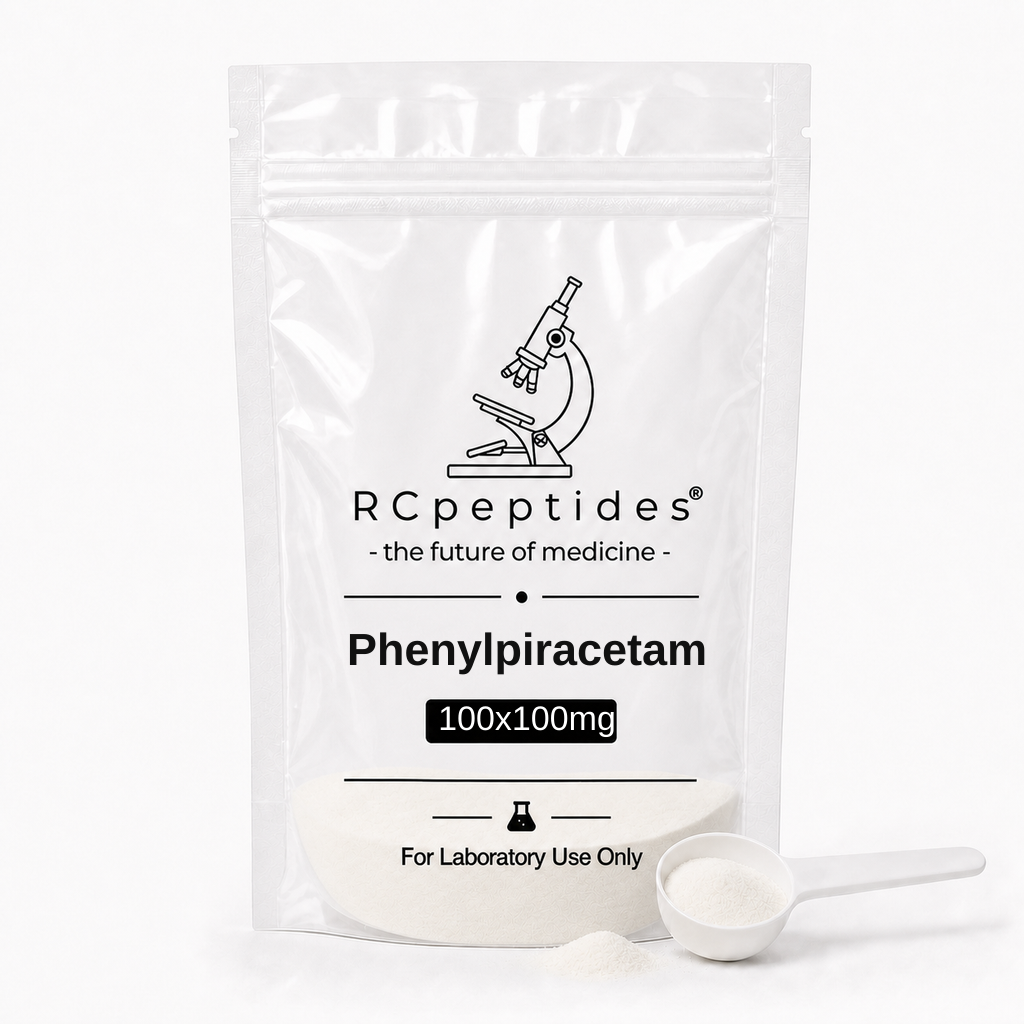
Phenylpiracetam 100x100mg
€90.00
Phenylpiracetam: Benefits, Mechanism, Safety & Research ReviewPhenylpiracetam, also known as fonturacetam, 4-phenylpiracetam or carphedon, is a synthetic racetam-class nootropic and stimulant-like compound structurally derived from piracetam by addition of a phenyl group. Its molecular formula is C₁₂H₁₄N₂O₂, molecu
NOT FOR HUMAN CONSUMPTION
Phenylpiracetam: Benefits, Mechanism, Safety & Research Review
Phenylpiracetam, also known as fonturacetam, 4-phenylpiracetam or carphedon, is a synthetic racetam-class nootropic and stimulant-like compound structurally derived from piracetam by addition of a phenyl group. Its molecular formula is C₁₂H₁₄N₂O₂, molecular weight approximately 218.25 g/mol, and CAS number 77472-70-9.
It has historically been used and studied mainly in Russia for conditions involving cognitive impairment, asthenia, stroke rehabilitation, brain injury and neurological dysfunction.
Unlike conventional piracetam, phenylpiracetam appears to have more pronounced effects on arousal, locomotor activity and catecholaminergic signaling, which probably contributes to its stimulant-like reputation.
Potential Benefits of Phenylpiracetam
|
Benefit |
Key take-away |
|---|---|
|
1 Cognitive function |
Human clinical studies report improvements in selected cognitive measures in neurological populations, although the overall evidence base is geographically concentrated and methodologically variable. |
|
2 Attention & mental performance |
Phenylpiracetam appears more stimulating than piracetam and may influence attention, alertness and psychomotor performance. |
|
3 Asthenia / fatigue |
A 2025 meta-analysis covering 549 patients found significant improvement in asthenia scores after one month of fonturacetam treatment. |
|
4 Post-stroke rehabilitation |
Controlled studies have reported improvements in functional and cognitive recovery after ischemic stroke. |
|
5 Brain injury / encephalopathy |
Clinical studies suggest possible improvements in memory, attention, motor function and daily activity following acquired brain injury. |
|
6 Epilepsy adjunct therapy |
One randomized placebo-controlled trial reported reduced seizure frequency and improved cognition when phenotropil was added to antiepileptic therapy. |
|
7 Dopaminergic activity |
S-phenylpiracetam has demonstrated selective dopamine transporter (DAT) inhibition in experimental research. |
|
8 Physical performance |
Stimulant-like and adaptogenic effects have historically been reported, but modern controlled performance data are limited. |
|
9 Healthy cognition |
Strong evidence for substantial cognitive enhancement in healthy individuals remains limited. |
2. Phenylpiracetam Mechanism of Action
2.1 Racetam and Catecholaminergic Activity
Phenylpiracetam’s exact mechanism is not completely established.
Like other racetams, it has been associated with effects on:
-
synaptic plasticity
-
cognition-related neurotransmission
-
neuronal membrane function
-
learning and memory pathways
However, phenylpiracetam appears pharmacologically distinct from piracetam because the phenyl substitution increases CNS activity and produces more pronounced psychostimulant-like effects.
2.2 Dopamine Transporter Signaling
One particularly important mechanistic finding concerns the dopamine transporter.
Experimental research identified S-phenylpiracetam as a selective dopamine transporter inhibitor, without comparable direct effects on norepinephrine or serotonin transporters in that experimental system.
DAT inhibition can increase extracellular dopamine signaling and may contribute to:
-
motivation,
-
wakefulness,
-
locomotor activity,
-
cognitive engagement,
-
reduced fatigue.
However, the marketed racemic compound contains both R- and S-enantiomers, and their pharmacological effects differ.
3. R-Phenylpiracetam vs S-Phenylpiracetam
Phenylpiracetam is normally a racemic mixture.
Preclinical studies suggest considerable stereoselectivity.
R-Phenylpiracetam
R-phenylpiracetam showed stronger:
-
memory-enhancing activity,
-
locomotor stimulation,
-
antidepressant-like activity
in animal behavioral testing.
Memory enhancement in one passive-avoidance model occurred with R-phenylpiracetam but not S-phenylpiracetam.
S-Phenylpiracetam
S-phenylpiracetam has been characterized particularly for:
-
dopamine transporter inhibition
-
metabolic effects
-
reduced body-weight gain in animal models
S-phenylpiracetam reduced fat accumulation, glucose and leptin levels in obese rodents without increasing locomotor activity in the relevant experiments.
This means the two enantiomers should not automatically be considered pharmacologically interchangeable.
4. Proposed Downstream Biology
|
Pathway |
Functional outcome |
Evidence |
|---|---|---|
|
Dopamine transporter inhibition |
Dopaminergic signaling ↑ |
Preclinical |
|
Synaptic plasticity |
Learning / memory support |
Preclinical + indirect clinical |
|
CNS activation |
Alertness / psychomotor activity |
Preclinical + clinical observations |
|
Neuroplasticity |
Potential neurological recovery |
Translational |
|
Metabolic signaling |
Reduced weight gain / glucose effects |
S-enantiomer, animal data |
A simplified model is:
Phenylpiracetam → racetam-like neuroplasticity + catecholaminergic modulation → increased cognitive/psychomotor activation
5. Human Clinical Evidence
5.1 Stroke Rehabilitation
One controlled clinical study examined approximately 400 patients with ischemic stroke, half of whom received phenotropil as part of rehabilitation.
Phenylpiracetam was associated with improvements in recovery outcomes during the year following stroke.
Other smaller studies have also evaluated phenylpiracetam following cerebrovascular injury.
5.2 Acquired Brain Injury
A comparative study involving 99 patients with neurological deficits following:
-
stroke,
-
traumatic brain injury,
-
brain-tumor surgery
reported improvements in:
-
memory,
-
attention,
-
motor coordination,
-
higher cognitive functions,
-
daily activity
during phenotropil treatment.
These findings are clinically interesting but do not meet the evidentiary standard of large modern multinational Phase III trials.
6. Asthenia and Fatigue
Asthenia is one of the more extensively studied modern indications.
A 2025 systematic review and meta-analysis evaluated 11 studies involving 549 patients treated with fonturacetam.
At a daily dose of 200 mg for approximately one month, mean MFI-20 asthenia scores decreased by approximately:
16.3 points
with additional reported improvements in:
-
emotional state,
-
cognition,
-
sleep,
-
quality of life.
The overall adverse-event frequency was approximately 5.5%, with reported effects generally transient.
This represents one of the strongest aggregated clinical datasets currently available for phenylpiracetam.
7. Epilepsy Research
A randomized, double-blind, placebo-controlled trial studied phenotropil as adjunctive therapy in 90 adults with focal epilepsy.
Participants received:
-
100 mg,
-
200 mg,
-
or placebo.
Phenotropil was reported to reduce seizure frequency and improve cognitive measures in selected patients without epileptiform EEG abnormalities.
This finding is interesting but requires independent replication before phenylpiracetam could be considered an established epilepsy therapy.
8. Phenylpiracetam Pharmacokinetics
Publicly accessible high-quality human pharmacokinetic information is relatively limited compared with drugs such as piracetam or oxiracetam.
Phenyl substitution increases lipophilicity relative to piracetam and is generally understood to contribute to:
-
stronger CNS penetration,
-
greater potency,
-
more pronounced stimulant-like effects.
However, widely repeated online figures for:
-
exact half-life,
-
bioavailability,
-
peak concentration,
-
elimination time
are not supported by a comparably robust modern human PK literature.
Therefore, precise retail claims about phenylpiracetam pharmacokinetics should be interpreted cautiously.
9. Phenylpiracetam Safety and Side Effects
Clinical research generally suggests reasonable short-term tolerability, but the safety database is substantially smaller than for established medicines.
Reported or plausible adverse effects include:
-
insomnia,
-
increased activation,
-
restlessness,
-
headache,
-
anxiety or irritability,
-
cardiovascular stimulation,
-
appetite changes.
The 2025 asthenia meta-analysis reported adverse events in approximately 5.5% of treated patients, generally described as transient.
Long-term safety in healthy users remains inadequately characterized.
10. Important Safety Limitations
Major evidence gaps include:
-
prolonged daily use,
-
cardiovascular safety,
-
psychiatric effects in susceptible individuals,
-
dependence/tolerance potential,
-
interactions with stimulants,
-
pregnancy and breastfeeding,
-
high-dose exposure,
-
use in healthy young adults.
Commercial “nootropic” products may also differ substantially in purity from pharmaceutical preparations used in clinical studies.
11. Phenylpiracetam vs Piracetam
|
Feature |
Phenylpiracetam |
Piracetam |
|---|---|---|
|
Racetam |
Yes |
Yes |
|
CNS stimulation |
More pronounced |
Minimal |
|
Dopaminergic involvement |
Greater evidence |
Limited |
|
Cognitive clinical studies |
Yes |
Extensive |
|
Stroke research |
Yes |
Yes |
|
Asthenia research |
Yes |
Less specific |
|
Athletic stimulant potential |
Higher |
Low |
|
WADA prohibited |
Yes |
No comparable listing |
|
Healthy cognition evidence |
Limited |
Limited/mixed |
12. Sports and WADA Status
Phenylpiracetam is particularly important in competitive sport.
The 2026 WADA Prohibited List explicitly lists:
Fonturacetam [4-phenylpiracetam (carphedon)]
under S6.A Non-Specified Stimulants.
It is therefore prohibited in competition.
Phenylpiracetam has historically been associated with doping-control concerns because of its stimulant and physical-performance effects.
13. Regulatory and Research Status
-
Generic name: Fonturacetam
-
Common names: Phenylpiracetam, Phenotropil, Carphedon
-
CAS: 77472-70-9
-
Formula: C₁₂H₁₄N₂O₂
-
Molecular weight: 218.25 g/mol
-
Class: Racetam / nootropic / stimulant-like CNS agent
-
FDA-approved medicine: No evidence of FDA drug approval
-
WADA: Prohibited in competition
FDA’s substance registry recognizes fonturacetam as a defined substance but explicitly notes that a UNII listing does not imply regulatory review or approval.
14. Evidence Profile
|
Claim |
Evidence strength |
|---|---|
|
CNS-active racetam |
Strong |
|
Greater stimulant activity than piracetam |
Moderate–strong |
|
R/S enantiomers differ pharmacologically |
Strong preclinical |
|
S-enantiomer inhibits DAT |
Strong preclinical |
|
Improves asthenia |
Moderate clinical evidence |
|
Benefits post-stroke recovery |
Moderate but older/regional evidence |
|
Improves cognition after neurological injury |
Moderate |
|
Improves cognition in epilepsy patients |
Preliminary RCT evidence |
|
Improves cognition in healthy adults |
Weak / insufficient |
|
Improves athletic performance |
Plausible but poorly quantified clinically |
|
Long-term safety is established |
No |
15. Future Directions
Future phenylpiracetam research should focus on:
-
modern randomized multicenter trials,
-
direct R- vs S-enantiomer comparisons,
-
full human pharmacokinetic characterization,
-
dopamine-transporter occupancy studies,
-
cardiovascular safety,
-
long-term neuropsychiatric effects,
-
stroke and brain-injury rehabilitation,
-
objectively measured fatigue and cognitive performance,
-
efficacy in healthy versus cognitively impaired populations.
A particularly interesting research direction is separation of R-phenylpiracetam’s cognitive profile from S-phenylpiracetam’s dopaminergic/metabolic activity.
16. Overall Evidence Assessment
Phenylpiracetam is a more pharmacologically active and stimulant-like racetam than conventional piracetam.
Its scientific literature includes genuine human clinical studies in:
-
asthenia,
-
stroke rehabilitation,
-
acquired brain injury,
-
epilepsy,
-
cognitive dysfunction.
A recent 2025 meta-analysis also provides supportive evidence for improvement of asthenia symptoms.
Best-supported findings
-
Racetam-class CNS activity
-
Greater psychostimulant activity than piracetam
-
Distinct pharmacology of R- and S-enantiomers
-
Dopamine-transporter activity of S-phenylpiracetam
-
Clinical evidence for reduced asthenia
-
Some evidence for neurological rehabilitation
-
Explicit WADA stimulant classification
Claims with weaker evidence
-
Major cognitive enhancement in healthy adults
-
Long-term productivity enhancement
-
Permanent memory improvement
-
Established athletic-performance enhancement
-
Long-term safety during chronic use
Overall: Phenylpiracetam (fonturacetam) is a clinically studied, stimulant-like racetam with evidence for anti-asthenic and neurological-rehabilitation effects and notable dopaminergic pharmacology. Its evidence base is stronger than that of many experimental nootropics, but healthy-person cognitive enhancement and long-term safety remain insufficiently established.
| Form |
Powder |
|---|
Related products

Bioglutide 10mg
Price range: €295.00 through €2,507.50
Bioglutide flacon 5mg
Price range: €170.00 through €1,445.00
Reviews
There are no reviews yet.