
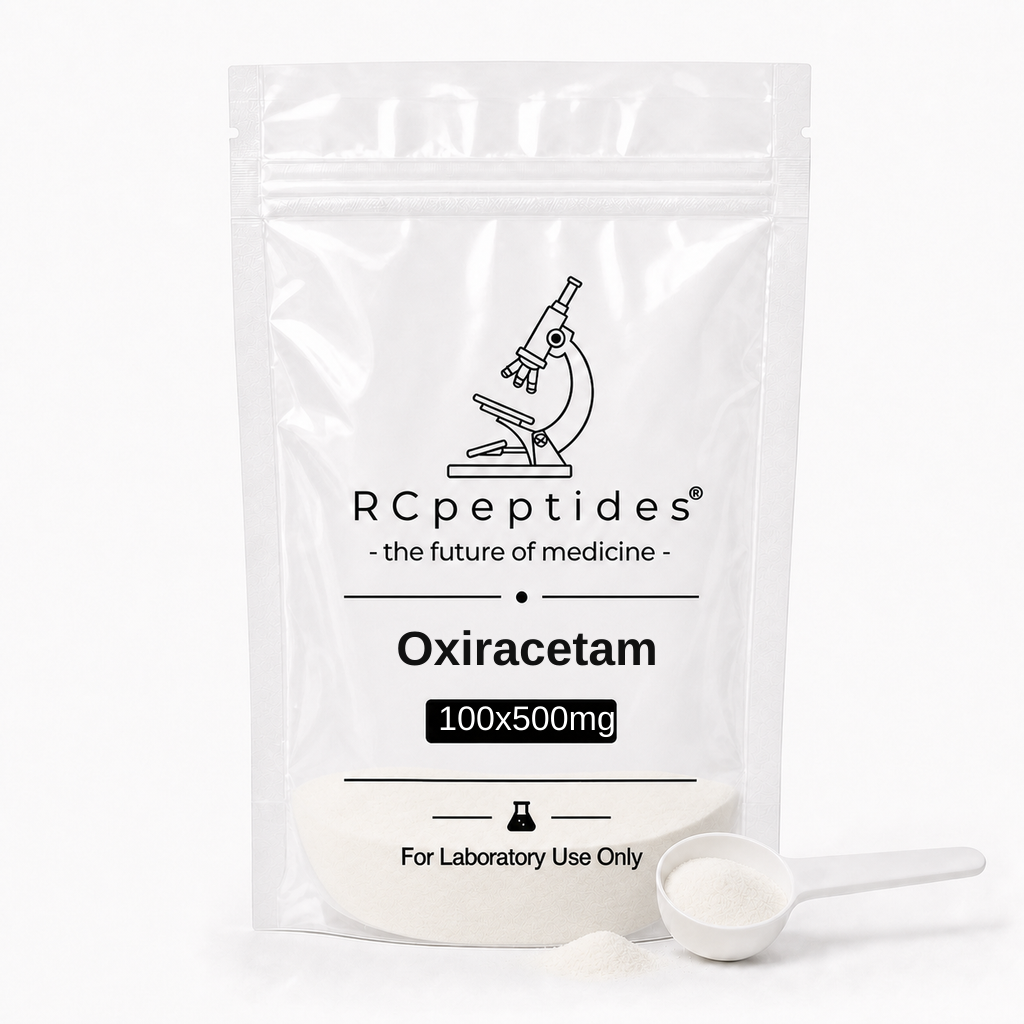
Oxiracetam 100x500mg
€80.00
Oxiracetam: Benefits, Mechanism, Safety & Research ReviewOxiracetam is a racetam-class nootropic compound structurally related to piracetam. It has been investigated primarily for memory, attention, dementia, vascular cognitive impairment, traumatic brain injury, and post-stroke cognitive dysfunction. Unlike many e
NOT FOR HUMAN CONSUMPTION
Oxiracetam: Benefits, Mechanism, Safety & Research Review
Oxiracetam is a racetam-class nootropic compound structurally related to piracetam. It has been investigated primarily for memory, attention, dementia, vascular cognitive impairment, traumatic brain injury, and post-stroke cognitive dysfunction. Unlike many experimental nootropics, oxiracetam has been evaluated in multiple human clinical trials.
Its exact mechanism is not fully established, but available evidence suggests modulation of glutamatergic and cholinergic neurotransmission, particularly within hippocampal circuits involved in learning and memory.
Potential Benefits of Oxiracetam
|
Benefit |
Key take-away |
|---|---|
|
1 Memory & learning |
Older controlled studies reported improvements in selected memory and neuropsychological measures, particularly in cognitively impaired patients. |
|
2 Attention & processing |
Some trials found improvements in attention, reaction time and continuous-performance measures. |
|
3 Dementia cognition |
Several older RCTs reported cognitive benefits, although Alzheimer’s-specific results were inconsistent. |
|
4 Vascular cognitive impairment |
Historical studies suggest possible benefit in vascular or multi-infarct dementia. |
|
5 Post-stroke cognition |
Recent research has investigated oxiracetam for cognitive decline following stroke. |
|
6 Traumatic brain injury |
Modern Phase III evidence suggests L-oxiracetam may improve cognitive recovery after mild-to-moderate TBI. |
|
7 Synaptic plasticity |
Preclinical research indicates modulation of hippocampal excitatory neurotransmission. |
|
8 Cholinergic signaling |
Experimental studies show increased stimulus-evoked acetylcholine release. |
|
9 Healthy cognition |
Evidence for meaningful cognitive enhancement in healthy adults remains limited. |
2. Oxiracetam Mechanism of Action
2.1 Neurotransmitter Pharmacodynamics
-
Glutamatergic modulation: Oxiracetam appears to enhance excitatory neurotransmission and may influence AMPA-associated synaptic plasticity.
-
Acetylcholine signaling: Experimental hippocampal studies show increased stimulus-evoked acetylcholine release.
-
Hippocampal plasticity: These mechanisms may support learning, memory encoding and long-term potentiation.
-
Not a classical stimulant: Oxiracetam does not primarily act through dopamine or noradrenaline stimulation.
2.2 Proposed Downstream Biology
|
Pathway |
Functional outcome |
Context |
|---|---|---|
|
Glutamate signaling ↑ |
Enhanced excitatory transmission |
Hippocampus |
|
AMPA-linked plasticity |
Improved synaptic strengthening |
Learning/memory |
|
Acetylcholine release ↑ |
Attention and memory support |
Cholinergic signaling |
|
Neuroplasticity |
Potential cognitive recovery |
Neurological injury |
3. Oxiracetam Pharmacokinetics
-
Absorption: Rapidly absorbed after oral administration.
-
Tmax: Approximately 1–2 hours for racemic oxiracetam; around 0.75–1 hour for S-oxiracetam under fasting conditions.
-
Bioavailability: Historical studies suggest approximately 75% oral bioavailability.
-
Half-life: Modern S-oxiracetam studies report approximately 6.1–6.6 hours in healthy adults.
-
Elimination: Primarily renal, with a substantial proportion excreted unchanged.
-
Renal impairment: Half-life can become markedly prolonged as kidney function declines.
-
Metabolism: Relatively limited compared with many CNS-active drugs.
4. Preclinical and Translational Evidence
4.1 Cell and Animal Systems
Experimental studies suggest oxiracetam can enhance:
-
hippocampal glutamate release
-
acetylcholine release
-
synaptic plasticity
-
learning-related neuronal signaling
These effects provide a plausible biological explanation for the cognitive signals observed in some human studies.
4.2 Human Data
Unlike many nootropics, oxiracetam has been examined in multiple controlled clinical trials.
Older studies reported benefits in selected measures of:
-
memory,
-
attention,
-
global cognition,
-
activities of daily living.
However, results were inconsistent, particularly in Alzheimer’s disease.
Evidence quality note: Human evidence exists, but much of the dementia literature is several decades old and uses heterogeneous patient populations and cognitive endpoints.
5. L-Oxiracetam / S-Oxiracetam
Conventional oxiracetam is a racemic mixture containing two enantiomers.
Modern research increasingly focuses on S-oxiracetam, also called L-oxiracetam, which appears to be the pharmacologically preferred enantiomer.
A large 2025 Phase III randomized trial in approximately 590 patients with mild-to-moderate traumatic brain injury found greater improvement in cognitive function with L-oxiracetam than with placebo.
L-oxiracetam also outperformed racemic oxiracetam on the primary cognitive outcome.
This makes L-oxiracetam after TBI one of the strongest modern clinical signals in the oxiracetam literature.
6. Clinical Research
|
Field |
Evidence |
Current status |
|---|---|---|
|
Dementia |
Multiple older RCTs |
Mixed/moderate evidence |
|
Alzheimer’s disease |
Positive and negative studies |
Inconsistent |
|
Vascular dementia |
Historical positive signals |
Moderate/heterogeneous |
|
Traumatic brain injury |
Modern Phase III trial |
Promising |
|
Post-stroke cognition |
Recent multicenter research |
Emerging |
|
Healthy cognition |
Limited controlled evidence |
Unproven |
7. Oxiracetam Safety and Side Effects
Oxiracetam has generally been well tolerated in controlled clinical studies.
Reported adverse events were usually mild and nonspecific, with few major laboratory abnormalities.
Important considerations include:
-
Renal clearance: impaired kidney function can substantially increase exposure.
-
Long-term safety: insufficiently characterized in healthy long-term users.
-
Pregnancy/breastfeeding: safety is not established.
-
Drug interactions: incompletely studied.
-
Product quality: online “nootropic” products may not match pharmaceutical-grade material used in clinical trials.
Modern Phase I studies of S-oxiracetam also reported generally favorable short-term tolerability.
8. Comparative Evidence Profile
|
Concern |
Oxiracetam |
Piracetam |
Typical experimental nootropic |
|---|---|---|---|
|
Human trials |
Multiple |
Extensive |
Often limited |
|
Human PK |
Yes |
Yes |
Variable |
|
Dementia research |
Yes |
Yes |
Often absent |
|
Modern Phase III data |
Yes, L-oxiracetam/TBI |
Limited for comparable indication |
Rare |
|
Healthy cognition evidence |
Weak |
Weak/mixed |
Usually weak |
|
Main elimination |
Renal |
Renal |
Variable |
|
Long-term healthy-user safety |
Uncertain |
Better characterized |
Often uncertain |
9. Regulatory and Research Status
-
Clinical history: Oxiracetam has been investigated and historically used in some jurisdictions for cognitive disorders.
-
International status: Regulatory status varies by country.
-
Healthy-person nootropic use: Not supported by strong clinical efficacy evidence.
-
Research trend: Increasing focus on L-/S-oxiracetam rather than conventional racemic oxiracetam.
10. Future Directions
Future oxiracetam research should focus on:
-
L-oxiracetam vs racemic oxiracetam
-
larger modern randomized trials
-
traumatic brain injury rehabilitation
-
post-stroke cognitive impairment
-
vascular cognitive dysfunction
-
biomarker-guided neurorehabilitation
-
long-term renal and neurological safety
-
better separation of Alzheimer’s and vascular cognitive disorders
11. Overall Evidence Assessment
Oxiracetam has a stronger human evidence base than many compounds marketed as nootropics.
The strongest evidence supports its investigation in cognitive impairment and neurological rehabilitation, rather than general cognitive enhancement in healthy individuals.
Best-supported findings
-
Human pharmacokinetics are reasonably well characterized.
-
Oxiracetam is largely eliminated through the kidneys.
-
Short-term tolerability appears generally favorable.
-
Multiple controlled human cognitive studies exist.
-
L-oxiracetam has promising modern Phase III evidence following traumatic brain injury.
Claims with weaker evidence
-
Significant cognitive enhancement in healthy adults
-
Increased intelligence
-
Permanent memory enhancement
-
Reliable treatment of Alzheimer’s disease
Overall: Oxiracetam is a clinically investigated racetam with plausible glutamatergic/cholinergic mechanisms, meaningful human research and renewed interest in L-oxiracetam, but its reputation as a general-purpose nootropic exceeds the strength of current evidence.
| Form |
Powder |
|---|
Related products
Acetic Water 0.6% 3ML
Price range: €5.00 through €42.50
Bioglutide flacon 5mg
Price range: €170.00 through €1,445.00
Reviews
There are no reviews yet.