
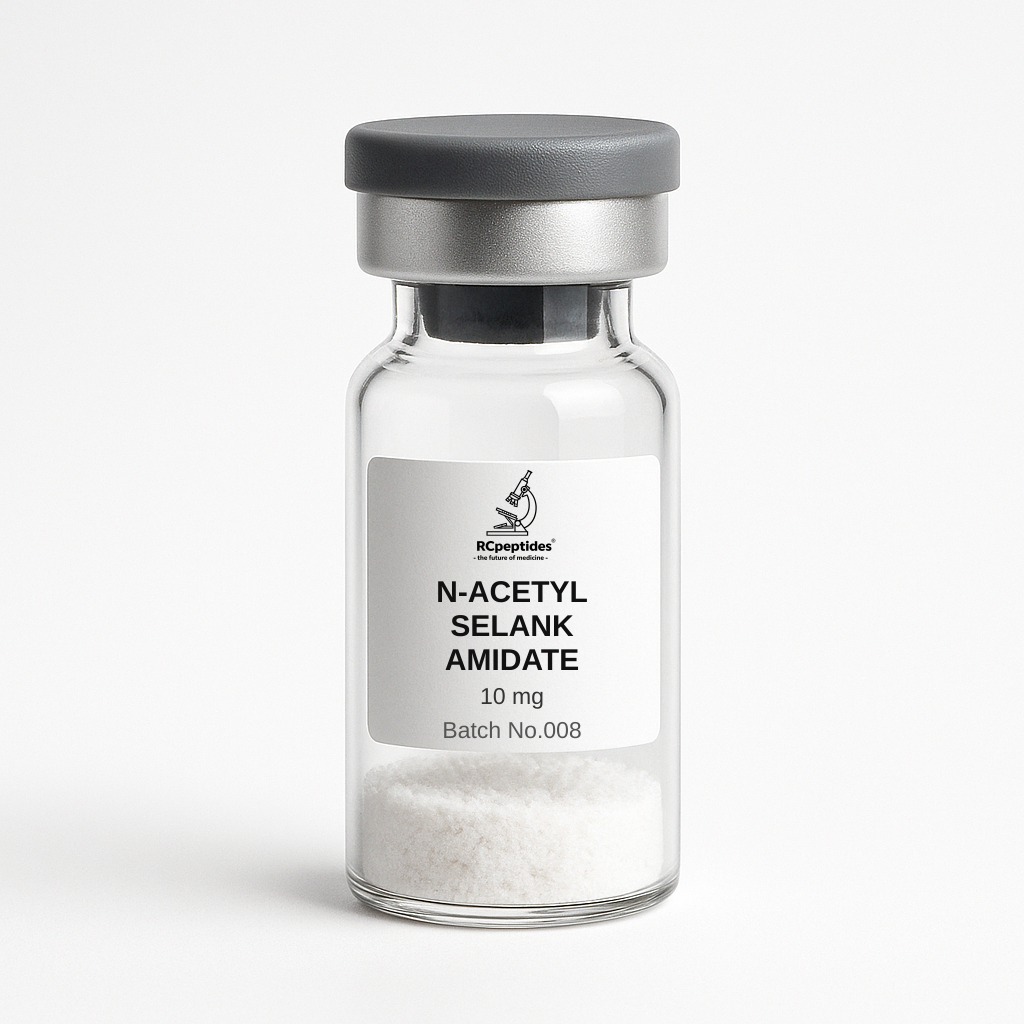
N-Acetyl-Selank Amidate 10mg vial
Price range: €50.00 through €425.00
N-Acetyl-Selank Amidate, 10 mg research vial. Batch No.008. Terminally acetylated and amidated analogue; direct research remains limited.
10 mg vial · Batch No.008
N-Acetyl-Selank Amidate: Benefits, Mechanism, Safety & Research Review
N-Acetyl-Selank Amidate, also known as NA-Selank Amidate, is a modified analogue of Selank, the synthetic heptapeptide Thr-Lys-Pro-Arg-Pro-Gly-Pro (TKPRPGP).
The analogue is generally represented as:
Ac-TKPRPGP-NH₂
It combines N-terminal acetylation with C-terminal amidation, two structural modifications commonly used in peptide research to investigate changes in enzymatic stability, biological persistence and peptide activity.
Most available research concerns native Selank rather than N-Acetyl-Selank Amidate itself. Therefore, many proposed effects of the modified analogue remain extrapolated from Selank research rather than directly demonstrated.
1. Potential Benefits of N-Acetyl-Selank Amidate
| Benefit | Key take-away |
|---|---|
| 1. Anxiety-related research | Native Selank has shown anxiolytic activity in small human studies, but this has not been directly confirmed for NA-Selank Amidate. |
| 2. GABAergic signaling | Selank appears to influence GABA-related neurotransmission and receptor-associated signaling. |
| 3. Cognitive support | Animal and limited clinical research with Selank suggests possible effects on attention, learning and memory. |
| 4. Stress regulation | Selank has been investigated for its effects on stress-related neurochemical pathways. |
| 5. BDNF modulation | Preclinical research suggests Selank can influence BDNF and neuroplasticity-related signaling. |
| 6. Enkephalin metabolism | Selank has demonstrated effects on enkephalin degradation in experimental studies. |
| 7. Monoamine signaling | Research suggests interactions with serotonergic and noradrenergic pathways. |
| 8. Peptide stability | Acetylation and amidation may theoretically alter resistance to enzymatic degradation. |
| 9. Longer biological activity | Frequently proposed for modified Selank analogues, but not directly established. |
| 10. Neuroplasticity research | Selank-related compounds remain of interest for studying neuronal adaptation and signaling. |
2. N-Acetyl-Selank Amidate Mechanism of Action
2.1 GABAergic Signaling
One of the main proposed mechanisms associated with Selank involves modulation of the GABAergic system.
GABA is the primary inhibitory neurotransmitter in the central nervous system and plays an important role in:
- neuronal excitability,
- stress responses,
- anxiety regulation,
- sleep,
- emotional processing.
Experimental research suggests Selank can influence GABA receptor-associated signaling and may modify GABA-related gene expression.
A simplified model is:
Selank-type signaling → GABAergic modulation → altered neuronal excitability → stress and anxiety-related effects
N-Acetyl-Selank Amidate has not yet been shown to produce stronger or longer-lasting GABAergic activity than native Selank.
2.2 Proposed Downstream Biology
| Pathway | Functional outcome | Context |
|---|---|---|
| GABA signaling ↑ | Reduced neuronal excitability | Anxiety / stress |
| BDNF signaling | Neuroplasticity regulation | Learning / adaptation |
| Enkephalin metabolism | Altered neuropeptide activity | Stress / emotional processing |
| Serotonin signaling | Neurotransmitter modulation | Mood / stress |
| Noradrenaline signaling | Attention and arousal modulation | Cognition |
| Gene expression changes | Altered neuronal signaling | CNS function |
A simplified model is:
Selank-related peptide signaling → neurotransmitter and neuropeptide modulation → altered neuronal activity → behavioral and cognitive effects
3. BDNF and Neuroplasticity
Selank has been studied for its effects on brain-derived neurotrophic factor (BDNF).
BDNF contributes to:
- synaptic plasticity,
- learning,
- memory,
- neuronal survival,
- adaptation to stress.
Animal studies have reported changes in BDNF-related signaling following Selank administration.
This suggests a possible role in neuroplasticity, although direct evidence for N-Acetyl-Selank Amidate remains limited.
4. Enkephalin and Neuropeptide Signaling
Selank has also been investigated for its effects on enkephalin metabolism.
Enkephalins are endogenous opioid peptides involved in:
- pain regulation,
- emotional processing,
- stress,
- reward pathways.
Experimental research suggests Selank can inhibit the enzymatic degradation of enkephalins under laboratory conditions.
This may contribute to some of its reported neurochemical effects.
Whether N-Acetyl-Selank Amidate produces the same effect has not yet been established.
5. Preclinical Evidence
Preclinical studies of native Selank have reported effects involving:
- GABAergic signaling,
- gene expression,
- BDNF,
- serotonin,
- noradrenaline,
- learning,
- memory,
- attention,
- stress responses.
Several animal models have shown improvements in cognitive or behavioral performance under experimentally impaired conditions.
However, these findings should not automatically be applied directly to N-Acetyl-Selank Amidate.
The modified analogue remains substantially less characterized.
6. Human Selank Research
Native Selank has been evaluated in small human clinical studies, primarily involving anxiety-related disorders.
Reported outcomes have included:
- reduced anxiety,
- improved emotional stability,
- mild antiasthenic effects,
- limited sedation,
- possible cognitive benefits.
Some studies compared Selank with benzodiazepine-type drugs such as medazepam or phenazepam.
These findings provide preliminary evidence for native Selank, but no equivalent controlled human trial has established the clinical efficacy of N-Acetyl-Selank Amidate.
7. N-Acetyl-Selank Amidate and Cognitive Effects
Selank is often described as both an anxiolytic and nootropic peptide.
Preclinical research suggests possible effects on:
- attention,
- learning,
- memory,
- stress-related cognition,
- exploratory behavior.
However, evidence that Selank enhances cognition in healthy humans remains limited.
For N-Acetyl-Selank Amidate specifically, controlled human cognitive research is currently lacking.
8. N-Acetyl-Selank Amidate Pharmacokinetics
Direct pharmacokinetic data for N-Acetyl-Selank Amidate are extremely limited.
Important parameters remain unknown, including:
- plasma half-life,
- Tmax,
- Cmax,
- intranasal bioavailability,
- brain exposure,
- metabolic products,
- elimination rate.
Native Selank is known to undergo enzymatic degradation into shorter peptide fragments.
N-terminal acetylation and C-terminal amidation may theoretically alter this degradation pattern, but direct comparative pharmacokinetic evidence is still lacking.
9. N-Acetyl-Selank Amidate Half-Life
The exact N-Acetyl-Selank Amidate half-life has not been reliably established.
Terminal acetylation and amidation can increase resistance to enzymatic degradation in some peptides.
Therefore, longer persistence is chemically plausible.
However:
greater theoretical stability does not automatically mean a proven longer biological half-life.
Direct comparative studies with native Selank are required.
10. N-Acetyl-Selank Amidate Safety and Tolerability
Native Selank Safety
Small clinical studies generally reported native Selank as relatively well tolerated.
Compared with benzodiazepine-type drugs, Selank has been associated with:
- less sedation,
- less cognitive impairment,
- fewer classical benzodiazepine-type effects.
However, the available clinical database remains small.
N-Acetyl-Selank Amidate Safety
The exact safety profile of N-Acetyl-Selank Amidate remains unknown.
Important unanswered questions include:
- long-term neurological effects,
- cardiovascular effects,
- hepatic effects,
- renal effects,
- reproductive toxicity,
- pregnancy safety,
- immune reactions,
- drug interactions,
- tolerance,
- withdrawal.
11. N-Acetyl-Selank Amidate vs Selank
| Feature | Selank | N-Acetyl-Selank Amidate |
|---|---|---|
| Peptide sequence | TKPRPGP | Ac-TKPRPGP-NH₂ |
| N-terminal acetylation | No | Yes |
| C-terminal amidation | No | Yes |
| Human studies | Limited | None established |
| GABA research | Yes | Extrapolated |
| BDNF research | Yes | Extrapolated |
| Enkephalin research | Yes | Extrapolated |
| Proven longer half-life | — | No |
| Proven higher potency | — | No |
| Proven better bioavailability | — | No |
| Long-term safety | Unknown | Unknown |
N-Acetyl-Selank Amidate should therefore be viewed as a distinct experimental Selank analogue, rather than a proven stronger version of native Selank.
12. Evidence Profile
| Claim | Evidence strength |
|---|---|
| Native Selank has anxiolytic effects | Preliminary human evidence |
| Selank influences GABA signaling | Moderate preclinical evidence |
| Selank affects BDNF | Preclinical evidence |
| Selank alters gene expression | Preclinical evidence |
| Selank affects enkephalin metabolism | Mechanistic evidence |
| Selank influences monoamine signaling | Preclinical evidence |
| Selank may support cognition | Preclinical / limited clinical evidence |
| NA-Selank Amidate reduces anxiety | Unknown |
| NA-Selank Amidate improves cognition | Unknown |
| NA-Selank Amidate has longer half-life | Unproven |
| NA-Selank Amidate has better brain penetration | Unproven |
| NA-Selank Amidate is more potent | Unproven |
| Long-term human safety | Unknown |
13. Regulatory and Research Status
- Name: N-Acetyl-Selank Amidate
- Alternative name: NA-Selank Amidate
- Peptide backbone: TKPRPGP
- Proposed structure: Ac-TKPRPGP-NH₂
- Compound class: Modified Selank analogue
- Research area: Neuroscience, peptide pharmacology and neuroplasticity
- Clinical stage: Experimental
- Approved medicine: No
Native Selank has substantially more published research than N-Acetyl-Selank Amidate, including limited human clinical studies.
The modified analogue remains largely experimental.
14. Future Research
Future studies should determine:
- direct pharmacokinetics,
- plasma stability,
- intranasal bioavailability,
- brain penetration,
- dose-response relationships,
- receptor pharmacology,
- metabolic pathways,
- comparative activity versus Selank,
- chronic safety,
- immune effects,
- cognitive effects,
- anxiolytic efficacy.
A direct comparison between Selank, N-Acetyl Selank and N-Acetyl-Selank Amidate would be particularly valuable.
15. Overall Evidence Assessment
N-Acetyl-Selank Amidate is an interesting experimental analogue because it combines the known TKPRPGP Selank backbone with terminal acetylation and amidation.
The scientific rationale is that these modifications may alter peptide stability, enzymatic degradation and biological persistence.
Best-supported findings
- Native Selank has preliminary human anxiolytic evidence
- Selank influences GABA-related signaling
- Selank affects BDNF-related pathways
- Selank alters neuronal gene expression
- Selank affects enkephalin metabolism
- Selank interacts with monoamine signaling
- Terminal modification may alter peptide stability
Claims that remain uncertain
- Longer half-life
- Greater potency
- Better bioavailability
- Superior brain penetration
- Greater anxiolytic activity
- Stronger cognitive effects
- Long-term safety
- Superiority over native Selank
Overall: N-Acetyl-Selank Amidate is a modified Selank analogue with a plausible peptide-engineering rationale and an interesting neurochemical research profile. However, most current evidence originates from native Selank rather than the modified analogue itself. Direct pharmacokinetic, mechanistic and clinical studies are still needed before claims of greater potency, longer duration or superior biological activity can be established.
| Purchase option |
Single vial ,Whole kit |
|---|
Related products
ARA290 10mg vial
Price range: €60.00 through €510.00
CJC-1295 with DAC 10mg vial
Price range: €50.00 through €425.00
LL-37 5mg vial
Price range: €40.00 through €340.00
Pinealon 20mg vial
Price range: €55.00 through €467.50
rHGH Fragment 176–191 10mg vial
Price range: €50.00 through €425.00
Tesamorelin 10mg vial
Price range: €60.00 through €510.00
Thymalin 10mg vial
Price range: €40.00 through €340.00
Reviews
There are no reviews yet.