
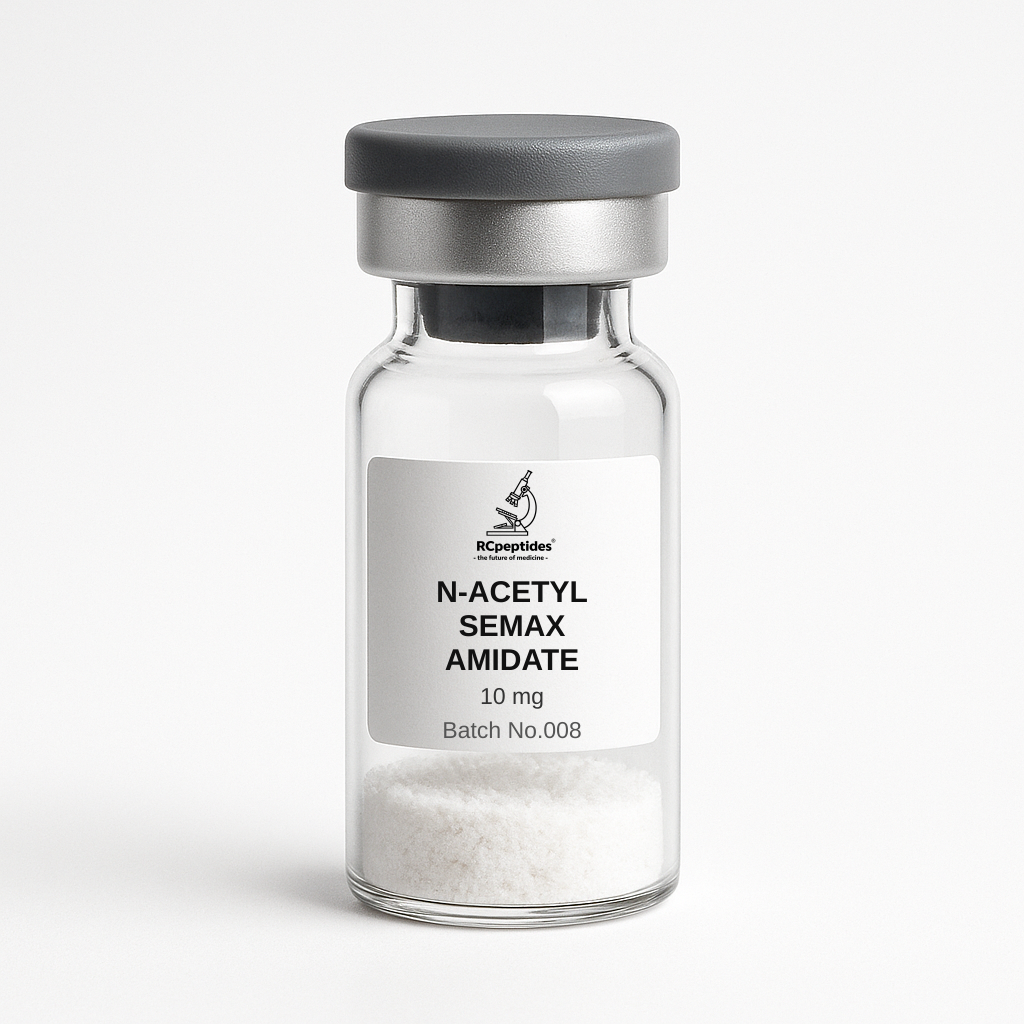
N-Acetyl-Semax Amidate 10mg vial
Price range: €50.00 through €425.00
N-Acetyl-Semax Amidate, 10 mg research vial. Batch No.008. Terminally acetylated and amidated analogue; direct research remains limited.
10 mg vial · Batch No.008
N-Acetyl-Semax Amidate: Benefits, Mechanism, Safety & Research Review
N-Acetyl-Semax Amidate, also known as NA-Semax Amidate, is a modified analogue of Semax, the synthetic heptapeptide Met-Glu-His-Phe-Pro-Gly-Pro (MEHFPGP).
The analogue is represented as:
Ac-Met-Glu-His-Phe-Pro-Gly-Pro-NH₂
or:
Ac-MEHFPGP-NH₂
PubChem lists N-Acetyl-Semax Amidate as CID 172638603, with molecular formula C₃₉H₅₄N₁₀O₁₀S and molecular weight approximately 855.0 g/mol.
It combines N-terminal acetylation with C-terminal amidation, two structural modifications commonly used in peptide research to investigate changes in enzymatic stability, biological persistence and peptide activity.
Most available research concerns native Semax rather than N-Acetyl-Semax Amidate itself. Therefore, many proposed effects of the modified analogue remain extrapolated from Semax research rather than directly demonstrated.
1. Potential Benefits of N-Acetyl-Semax Amidate
| Benefit | Key take-away |
|---|---|
| 1. Neuroprotection | Native Semax has demonstrated neuroprotective effects in multiple preclinical cerebral ischemia models. |
| 2. Cognitive support | Semax has been investigated for effects on memory, learning and attention. |
| 3. BDNF modulation | Semax increases BDNF-related signaling in several animal studies. |
| 4. NGF signaling | Research suggests Semax can influence nerve growth factor expression. |
| 5. Neuroplasticity | Neurotrophin and receptor signaling may contribute to neuronal adaptation and recovery. |
| 6. Ischemia-related research | Semax has an extensive preclinical research history in experimental cerebral ischemia. |
| 7. Gene expression | Semax alters expression of genes involved in neurotrophic, immune and neurotransmitter pathways. |
| 8. Inflammatory signaling | Experimental studies suggest modulation of inflammatory pathways after cerebral ischemia. |
| 9. Peptide stability | Acetylation and amidation may theoretically alter susceptibility to enzymatic degradation. |
| 10. Longer biological activity | Frequently proposed for modified Semax analogues, but not directly established for N-Acetyl-Semax Amidate. |
2. N-Acetyl-Semax Amidate Mechanism of Action
2.1 Neurotrophin Signaling
One of the best-characterized mechanisms associated with native Semax involves neurotrophic signaling.
Research has demonstrated effects on:
- BDNF
- NGF
- Trk receptors
- neuronal survival pathways
- synaptic plasticity
Intranasal Semax increased expression of both BDNF and NGF genes in the rat hippocampus, while other studies found changes in neurotrophins and their receptors following experimental cerebral ischemia.
A simplified model is:
Semax-related signaling → neurotrophin expression ↑ → neuronal plasticity and survival pathways ↑ → neuroprotective effects
Whether N-Acetyl-Semax Amidate produces stronger or longer-lasting neurotrophin effects has not been established.
2.2 Proposed Downstream Biology
| Pathway | Functional outcome | Context |
|---|---|---|
| BDNF signaling ↑ | Synaptic plasticity / neuronal survival | Cognition / neuroprotection |
| NGF signaling ↑ | Neuronal growth and maintenance | CNS function |
| CREB signaling ↑ | Recovery and plasticity pathways | Cerebral ischemia |
| Inflammatory signaling ↓ | Reduced inflammatory response | Neuroprotection |
| Neurotransmitter gene expression | Altered neuronal communication | CNS function |
| Neurotrophin receptors ↑ | Enhanced trophic signaling | Neuronal recovery |
A simplified model is:
Semax-related peptide signaling → neurotrophic and transcriptional changes → neuronal protection and plasticity → cognitive and recovery-related effects
3. BDNF and Neuroplasticity
Brain-derived neurotrophic factor (BDNF) is one of the most extensively studied pathways associated with Semax.
BDNF contributes to:
- synaptic plasticity,
- learning,
- memory,
- neuronal survival,
- neuronal adaptation.
Experimental studies have shown that Semax can increase BDNF protein or gene-expression signaling in several regions of the rat brain.
One study demonstrated specific Semax binding in rat basal forebrain together with increased BDNF protein levels following intranasal administration.
These findings support a role for neurotrophic signaling in the pharmacology of native Semax.
Direct evidence for N-Acetyl-Semax Amidate remains limited.
4. NGF and Neurotrophin Signaling
Semax has also been studied in relation to nerve growth factor (NGF) and neurotrophin receptors.
Research following cerebral ischemia showed changes in expression of:
- BDNF,
- NGF,
- NT-3,
- TrkA,
- TrkB,
- TrkC.
These findings suggest Semax affects a broader neurotrophic signaling network rather than acting only through BDNF.
This may partly explain its interest in neuroprotection and neuronal recovery research.
5. Preclinical Evidence
Native Semax has a substantial preclinical research history compared with many experimental peptides.
Animal studies have reported effects involving:
- cerebral ischemia,
- neuronal survival,
- infarct size,
- memory,
- neurotrophin expression,
- inflammatory signaling,
- gene expression,
- neurotransmission.
In experimental cortical ischemia, intranasal Semax reduced infarct volume and improved performance in a conditioned memory task.
Other studies suggest Semax influences neuroprotective processes through changes in immune-response genes, inflammatory pathways and neuronal signaling.
However, these results apply to native Semax, not directly to N-Acetyl-Semax Amidate.
6. Human Semax Research
Native Semax has also been investigated in human clinical research, particularly in neurological settings.
Older clinical research reported use of Semax during the acute phase of ischemic stroke, with investigators describing neuroprotective and anti-inflammatory effects.
Semax has additionally been discussed in relation to attention, memory and cognitive function, although much of this literature is relatively small and geographically concentrated. A review noted reported effects on memory and attention in both rodents and humans following intranasal administration.
These findings provide clinical context for native Semax.
However, no equivalent controlled human evidence has established the efficacy of N-Acetyl-Semax Amidate itself.
7. N-Acetyl-Semax Amidate and Cognitive Effects
Semax is widely associated with nootropic and cognitive research.
Reported areas of investigation include:
- memory,
- learning,
- attention,
- information processing,
- cognitive recovery after neurological injury.
Preclinical studies generally provide stronger evidence than modern controlled human trials.
Therefore, claims that N-Acetyl-Semax Amidate reliably enhances cognition in healthy humans remain unsupported.
No controlled clinical study has established that the acetylated/amidated analogue produces greater cognitive effects than native Semax.
8. N-Acetyl-Semax Amidate Pharmacokinetics
Direct pharmacokinetic data for N-Acetyl-Semax Amidate are extremely limited.
Important parameters remain unknown, including:
- plasma half-life,
- Tmax,
- Cmax,
- intranasal bioavailability,
- brain exposure,
- CSF concentrations,
- metabolic products,
- clearance.
The compound’s terminal modifications provide a reasonable structural basis for investigating altered degradation.
However, there is currently no high-quality published pharmacokinetic comparison showing that N-Acetyl-Semax Amidate has superior exposure or biological persistence compared with native Semax.
9. N-Acetyl-Semax Amidate Half-Life
The exact N-Acetyl-Semax Amidate half-life has not been reliably established.
Terminal acetylation and amidation can alter enzymatic degradation in some peptides.
Therefore:
terminal modification → potentially altered degradation → potentially longer persistence
is chemically plausible.
However:
greater theoretical stability does not equal a proven longer biological half-life.
Claims that N-Acetyl-Semax Amidate lasts several times longer than standard Semax currently lack direct pharmacokinetic confirmation.
10. N-Acetyl-Semax Amidate Safety and Tolerability
Native Semax Safety
Native Semax has been used in clinical research and has a substantially larger safety history than the modified analogue.
However, the available clinical literature remains considerably smaller than that of internationally approved neurological medications.
N-Acetyl-Semax Amidate Safety
For N-Acetyl-Semax Amidate itself, safety remains poorly characterized.
Important unknowns include:
- long-term neurological effects,
- cardiovascular effects,
- hepatic effects,
- renal effects,
- immune reactions,
- reproductive toxicity,
- pregnancy safety,
- drug interactions,
- tolerance,
- withdrawal,
- chronic exposure effects.
Structural modification can alter pharmacology as well as stability.
Therefore, native Semax safety data should not automatically be considered proof of safety for N-Acetyl-Semax Amidate.
11. N-Acetyl-Semax Amidate vs Semax
| Feature | Semax | N-Acetyl-Semax Amidate |
|---|---|---|
| Peptide sequence | MEHFPGP | Ac-MEHFPGP-NH₂ |
| N-terminal acetylation | No | Yes |
| C-terminal amidation | No | Yes |
| Human research | Yes, limited | No established direct trials |
| Neuroprotection research | Extensive preclinical | Extrapolated |
| BDNF research | Yes | Extrapolated |
| NGF research | Yes | Extrapolated |
| Ischemia research | Yes | Extrapolated |
| Proven longer half-life | — | No |
| Proven greater potency | — | No |
| Proven better bioavailability | — | No |
| Long-term safety | Limited | Unknown |
N-Acetyl-Semax Amidate should therefore be regarded as a distinct experimental Semax analogue, rather than a clinically proven stronger version of Semax.
12. Evidence Profile
| Claim | Evidence strength |
|---|---|
| Native Semax has neuroprotective effects | Strong preclinical evidence |
| Semax affects NGF signaling | Preclinical evidence |
| Semax alters neurotrophin receptor expression | Preclinical evidence |
| Semax reduces ischemic injury in animal models | Strong preclinical evidence |
| Semax alters inflammatory signaling | Preclinical evidence |
| Semax affects neuronal gene expression | Preclinical evidence |
| Native Semax has human neurological research | Limited clinical evidence |
| NA-Semax Amidate improves cognition | Unknown |
| NA-Semax Amidate is neuroprotective | Unknown |
| NA-Semax Amidate has longer half-life | Unproven |
| NA-Semax Amidate has better brain penetration | Unproven |
| NA-Semax Amidate is more potent | Unproven |
| Long-term human safety | Unknown |
13. Regulatory and Research Status
- Name: N-Acetyl-Semax Amidate
- Alternative name: NA-Semax Amidate
- Peptide backbone: MEHFPGP
- Structure: Ac-MEHFPGP-NH₂
- PubChem CID: 172638603
- Molecular formula: C₃₉H₅₄N₁₀O₁₀S
- Molecular weight: approximately 855.0 g/mol
- Compound class: Modified Semax analogue
- Research area: Neuroscience, neuroprotection and peptide pharmacology
- Clinical stage: Experimental
- FDA-approved medicine: No
PubChem confirms the acetylated and C-terminally amidated structure of the compound.
Native Semax has substantially more published research than N-Acetyl-Semax Amidate.
14. Future Research
Future studies should determine:
- direct pharmacokinetics,
- plasma stability,
- intranasal bioavailability,
- brain penetration,
- metabolic degradation,
- dose-response relationships,
- receptor and binding pharmacology,
- BDNF effects,
- NGF effects,
- neuroprotective activity,
- cognitive effects,
- chronic safety,
- comparative activity versus native Semax.
A direct comparison between Semax, N-Acetyl Semax and N-Acetyl-Semax Amidate would be particularly useful.
15. Overall Evidence Assessment
N-Acetyl-Semax Amidate is an interesting experimental peptide because it combines the MEHFPGP Semax backbone with N-terminal acetylation and C-terminal amidation.
Native Semax has a comparatively substantial preclinical evidence base involving neuroprotection, neurotrophins and cerebral ischemia.
Best-supported findings
- Native Semax has strong preclinical neuroprotective evidence
- Semax increases or alters BDNF-related signaling
- Semax influences NGF and neurotrophin pathways
- Semax affects neuronal gene expression
- Semax has demonstrated activity in cerebral ischemia models
- Semax influences inflammatory and recovery-related pathways
- Limited human neurological research exists for native Semax
- Terminal modification may alter peptide stability
Claims that remain uncertain
- Longer N-Acetyl-Semax Amidate half-life
- Greater potency
- Better bioavailability
- Superior brain penetration
- Stronger cognitive effects
- Greater neuroprotective activity
- Long-term safety
- Superiority over native Semax
Overall: N-Acetyl-Semax Amidate is a modified Semax analogue with a plausible peptide-engineering rationale and a scientifically interesting neuroprotective research background inherited from the parent Semax literature. However, direct research on the acetylated/amidated analogue itself remains very limited. Claims of greater potency, longer duration, improved brain penetration or superior cognitive effects require direct pharmacokinetic and controlled experimental confirmation.
| Purchase option |
Single vial ,Whole kit |
|---|
Related products
AICAR 100mg
Price range: €75.00 through €637.50
Gonadorelin 10mg vial
Price range: €50.00 through €425.00
Human chorionic gonadotropin(HCG) 5000iu vial
Price range: €32.50 through €276.25
LL-37 5mg vial
Price range: €40.00 through €340.00
Prostamax 20mg vial
Price range: €50.00 through €425.00
rHGH Fragment 176–191 10mg vial
Price range: €50.00 through €425.00
Reviews
There are no reviews yet.