
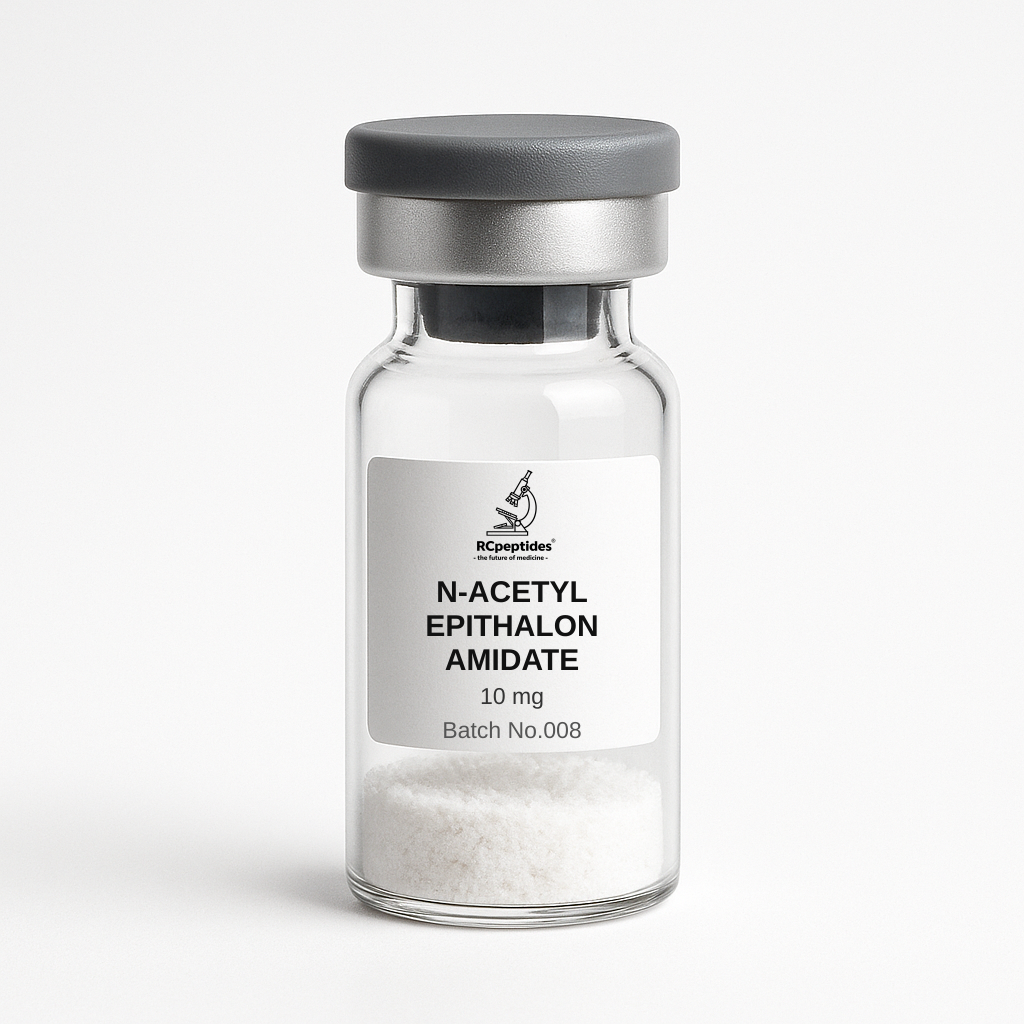


N-Acetyl-Epithalon Amidate 10mg vial
Price range: €50.00 through €425.00
N-Acetyl-Epithalon Amidate, 10 mg research vial. Batch No.008. Terminally acetylated and amidated analogue; direct research remains limited.
10 mg vial · Batch No.008
N-Acetyl-Epithalon Amidate: Benefits, Mechanism, Safety & Research Review
N-Acetyl-Epithalon Amidate, also known as N-Acetyl-Epitalon Amidate, NA-Epithalon Amidate or Ac-AEDG-NH₂, is a modified analogue of Epithalon (Epitalon), the synthetic tetrapeptide Ala-Glu-Asp-Gly (AEDG).
The analogue is generally represented as:
Ac-Ala-Glu-Asp-Gly-NH₂
or:
Ac-AEDG-NH₂
Native Epitalon is registered in PubChem as AEDG, with molecular formula C₁₄H₂₂N₄O₉ and molecular weight approximately 390.35 g/mol.
N-Acetyl-Epithalon Amidate combines N-terminal acetylation with C-terminal amidation, two structural modifications commonly used in peptide chemistry to investigate changes in enzymatic stability, degradation and biological persistence.
Most available scientific research concerns native Epitalon rather than N-Acetyl-Epithalon Amidate itself. Current searches have not identified direct peer-reviewed pharmacokinetic, safety or efficacy studies on the exact Ac-AEDG-NH₂ analogue.
1. Potential Benefits of N-Acetyl-Epithalon Amidate
| Benefit | Key take-away |
|---|---|
| 1. Telomere research | Native Epitalon has been investigated for effects on telomere length and telomerase activity. |
| 2. Telomerase signaling | A 2025 study reported increased hTERT expression and telomerase activity in normal human cell lines treated with Epitalon. |
| 3. Cellular aging research | Epitalon is widely studied in the context of cellular senescence and aging biology. |
| 4. Longevity research | Animal and cellular research has explored possible effects on lifespan and age-related processes. |
| 5. Melatonin regulation | Native Epitalon has been investigated for pineal and melatonin-related effects. |
| 6. Gene regulation | Epitalon has been studied for effects on gene expression and chromatin-associated processes. |
| 7. Neuroendocrine research | Its origin from pineal peptide research has led to interest in neuroendocrine signaling. |
| 8. Antioxidant pathways | Preclinical literature has explored possible antioxidant and cytoprotective effects. |
| 9. Peptide stability | Acetylation and amidation may theoretically alter resistance to enzymatic degradation. |
| 10. Longer biological persistence | Frequently proposed for the modified analogue, but not directly demonstrated. |
2. N-Acetyl-Epithalon Amidate Mechanism of Action
2.1 Telomerase and Telomere Signaling
The most recognized research area associated with Epitalon is telomere biology.
Telomeres are repetitive DNA sequences located at chromosome ends. They generally shorten during repeated cell division and are associated with cellular senescence and biological aging.
Telomerase can partly counteract this process by extending telomeric DNA.
A 2025 study using human epithelial and fibroblast cell lines found that Epitalon increased telomere length in association with increased hTERT mRNA expression and telomerase activity.
A simplified model is:
Epitalon-related signaling → hTERT expression ↑ → telomerase activity ↑ → telomere maintenance / extension
Whether N-Acetyl-Epithalon Amidate retains or enhances this activity has not been directly established.
2.2 Proposed Downstream Biology
| Pathway | Functional outcome | Context |
|---|---|---|
| hTERT expression ↑ | Telomerase production | Telomere biology |
| Telomerase activity ↑ | Telomere maintenance | Cellular aging |
| Telomere length ↑ | Delayed replicative shortening | Senescence research |
| Gene expression modulation | Altered cellular signaling | Aging biology |
| Melatonin-related signaling | Neuroendocrine regulation | Pineal research |
| Oxidative stress pathways | Cellular protection | Aging / stress biology |
A simplified model is:
Epitalon-related signaling → telomere and gene-regulatory pathways → altered cellular aging processes
3. Telomere Length and Cellular Aging
Epitalon has received particular attention because of its reported effects on telomere length.
A 2025 Biogerontology study found dose-dependent telomere extension in normal epithelial and fibroblast cells following Epitalon exposure. The effect was associated with increased hTERT expression and telomerase activity.
However, the same study also observed telomere extension in breast cancer cell lines through alternative lengthening of telomeres (ALT).
This finding is important because it shows that telomere biology is complex and that increasing telomere length should not automatically be interpreted as universally beneficial.
The study was also in vitro, not a human clinical trial.
4. Melatonin and Pineal Signaling
Epitalon was developed from research involving peptide fractions associated with the pineal gland.
This has led to investigation of possible effects on:
- melatonin production,
- circadian signaling,
- neuroendocrine regulation,
- age-related pineal function.
The broader Epitalon literature has reported interactions with melatonin-related physiology, although this evidence is substantially less mature than established sleep or circadian therapies.
Direct melatonin-related research on N-Acetyl-Epithalon Amidate has not been established.
5. Preclinical Evidence
Native Epitalon has been studied across several experimental areas, including:
- telomerase activity,
- telomere length,
- cellular senescence,
- lifespan in animal models,
- gene expression,
- melatonin signaling,
- oxidative stress,
- immune function,
- neuroendocrine biology.
A 2025 scientific review summarized decades of Epitalon research and identified telomere regulation, neuroendocrine signaling and geroprotective biology as major areas of investigation.
However, these findings relate primarily to native AEDG Epitalon.
They should not automatically be transferred to N-Acetyl-Epithalon Amidate.
6. Human Epitalon Research
Native Epitalon has a longer research history than the modified analogue, including older studies and observational work associated with aging and neuroendocrine function.
However, the human evidence base remains considerably less robust than that of approved medicines.
Important limitations include:
- small study populations,
- older study designs,
- limited independent replication,
- geographic concentration of the research,
- limited modern randomized clinical evidence.
Therefore, claims that Epitalon has been clinically proven to extend human lifespan remain unsupported.
For N-Acetyl-Epithalon Amidate specifically, no controlled human efficacy trial has been identified.
7. N-Acetyl-Epithalon Amidate and Longevity
Epitalon is frequently associated with longevity and anti-aging research.
Animal and cellular studies have investigated possible effects on:
- lifespan,
- cellular senescence,
- telomere maintenance,
- oxidative stress,
- age-related gene expression.
These findings make Epitalon scientifically interesting within aging research.
However:
telomere extension does not automatically equal longer human lifespan.
There is currently no high-quality evidence showing that N-Acetyl-Epithalon Amidate extends human lifespan or slows human aging.
8. N-Acetyl-Epithalon Amidate Pharmacokinetics
Direct pharmacokinetic data for N-Acetyl-Epithalon Amidate are currently lacking.
Important parameters remain unknown, including:
- plasma half-life,
- Tmax,
- Cmax,
- systemic bioavailability,
- tissue distribution,
- metabolic products,
- clearance,
- elimination.
The N-terminal acetyl group and C-terminal amide provide a reasonable chemical basis for investigating altered peptide degradation.
However, no direct published pharmacokinetic study has demonstrated superior exposure or stability compared with native Epitalon.
9. N-Acetyl-Epithalon Amidate Half-Life
The exact N-Acetyl-Epithalon Amidate half-life has not been established.
Terminal modifications can affect degradation by exopeptidases in some peptide systems.
Therefore:
acetylation + amidation → potentially altered degradation → potentially longer persistence
is chemically plausible.
However:
theoretical stability does not equal a proven longer biological half-life.
Claims of a specific extended half-life remain unsupported by direct pharmacokinetic data.
10. N-Acetyl-Epithalon Amidate Safety and Tolerability
Native Epitalon Safety
Native Epitalon has been studied for several decades, but its long-term human safety profile is still not characterized to the standard expected for approved medicines.
N-Acetyl-Epithalon Amidate Safety
The safety profile of the exact modified analogue remains largely unknown.
Important unanswered questions include:
- long-term toxicity,
- effects of chronic telomerase modulation,
- cancer-related implications,
- hepatic effects,
- renal effects,
- cardiovascular effects,
- reproductive toxicity,
- pregnancy safety,
- immune effects,
- drug interactions.
The 2025 cell study is particularly relevant because Epitalon affected telomere-maintenance pathways in both normal and cancer cell lines. The authors emphasized that the work was limited to in-vitro cell models.
11. N-Acetyl-Epithalon Amidate vs Epitalon
| Feature | Epitalon | N-Acetyl-Epithalon Amidate |
|---|---|---|
| Peptide sequence | AEDG | Ac-AEDG-NH₂ |
| N-terminal acetylation | No | Yes |
| C-terminal amidation | No | Yes |
| Telomere research | Yes | Extrapolated |
| Telomerase research | Yes | Extrapolated |
| Human research | Limited | No established direct trials |
| Longevity research | Preclinical / limited human | Extrapolated |
| Proven longer half-life | — | No |
| Proven greater potency | — | No |
| Proven improved bioavailability | — | No |
| Long-term safety | Uncertain | Unknown |
N-Acetyl-Epithalon Amidate should therefore be regarded as a distinct experimental Epitalon analogue, not as a proven stronger or longer-lasting version of Epitalon.
12. Evidence Profile
| Claim | Evidence strength |
|---|---|
| Native Epitalon affects telomerase activity and telomere length in human cell lines | Recent in-vitro evidence |
| Epitalon affects hTERT expression | In-vitro evidence |
| Epitalon has longevity effects in animal models | Preclinical evidence |
| Epitalon influences neuroendocrine pathways | Preclinical / older research |
| Epitalon affects melatonin-related biology | Preliminary evidence |
| Epitalon alters gene expression | Preclinical evidence |
| NA-Epithalon Amidate activates telomerase | Unknown |
| NA-Epithalon Amidate extends lifespan | Unknown |
| NA-Epithalon Amidate has longer half-life | Unproven |
| NA-Epithalon Amidate has better bioavailability | Unproven |
| NA-Epithalon Amidate is more potent | Unproven |
| Long-term human safety | Unknown |
13. Regulatory and Research Status
- Name: N-Acetyl-Epithalon Amidate
- Alternative names: N-Acetyl-Epitalon Amidate, NA-Epithalon Amidate
- Peptide backbone: AEDG
- Proposed structure: Ac-AEDG-NH₂
- Parent compound: Epitalon / Epithalon
- Parent PubChem CID: 219042
- Compound class: Modified Epitalon analogue
- Research area: Aging biology, telomeres and peptide pharmacology
- Clinical stage: Experimental
- FDA-approved medicine: No
A confirmed major public chemical-registry record for the exact acetylated/amidated derivative has not been established in the same way as for native Epitalon.
14. Future Research
Future studies should determine:
- exact chemical characterization,
- pharmacokinetics,
- plasma stability,
- tissue distribution,
- telomerase activity,
- hTERT regulation,
- telomere effects,
- metabolic degradation,
- dose-response relationships,
- cancer-related effects,
- longevity outcomes,
- chronic safety,
- comparative activity versus native Epitalon.
A direct comparison between Epitalon, N-Acetyl-Epitalon and N-Acetyl-Epithalon Amidate would be particularly valuable.
15. Overall Evidence Assessment
N-Acetyl-Epithalon Amidate is an interesting experimental analogue because it combines the AEDG Epitalon backbone with N-terminal acetylation and C-terminal amidation.
Native Epitalon has a substantial research history within telomere biology and experimental aging research.
Best-supported findings
- Native Epitalon affects telomerase-related pathways
- Epitalon can increase hTERT expression in human cell models
- Epitalon increased telomere length in normal human cell lines in a 2025 study
- Epitalon has extensive preclinical aging research
- Neuroendocrine and melatonin-related effects have been investigated
- Epitalon affects gene-regulatory pathways
- Terminal modification may alter peptide stability
Claims that remain uncertain
- Longer N-Acetyl-Epithalon Amidate half-life
- Greater potency
- Better bioavailability
- Stronger telomerase activation
- Greater telomere extension
- Human lifespan extension
- Anti-aging efficacy in humans
- Long-term safety
- Superiority over native Epitalon
Overall: N-Acetyl-Epithalon Amidate is a terminally modified Epitalon analogue with a plausible peptide-engineering rationale and a scientifically interesting background in telomere and aging research. However, virtually all meaningful biological evidence currently comes from native Epitalon rather than the modified Ac-AEDG-NH₂ analogue. Direct pharmacokinetic, mechanistic and controlled biological studies are required before claims of improved stability, greater potency, enhanced telomerase activity or superior longevity effects can be established.
| Purchase option |
Single vial ,Whole kit |
|---|
Related products
5-Amino-1-MQ 50mg vial
Price range: €60.00 through €510.00
AHK-CU 100mg vial
Price range: €52.50 through €446.25
AOD9604 10mg vial
Price range: €50.00 through €425.00
ARA290 10mg vial
Price range: €60.00 through €510.00
GLP-3 30mg vial
Price range: €170.00 through €1,445.00

Pinealon 20mg vial
Price range: €55.00 through €467.50
Reviews
There are no reviews yet.