
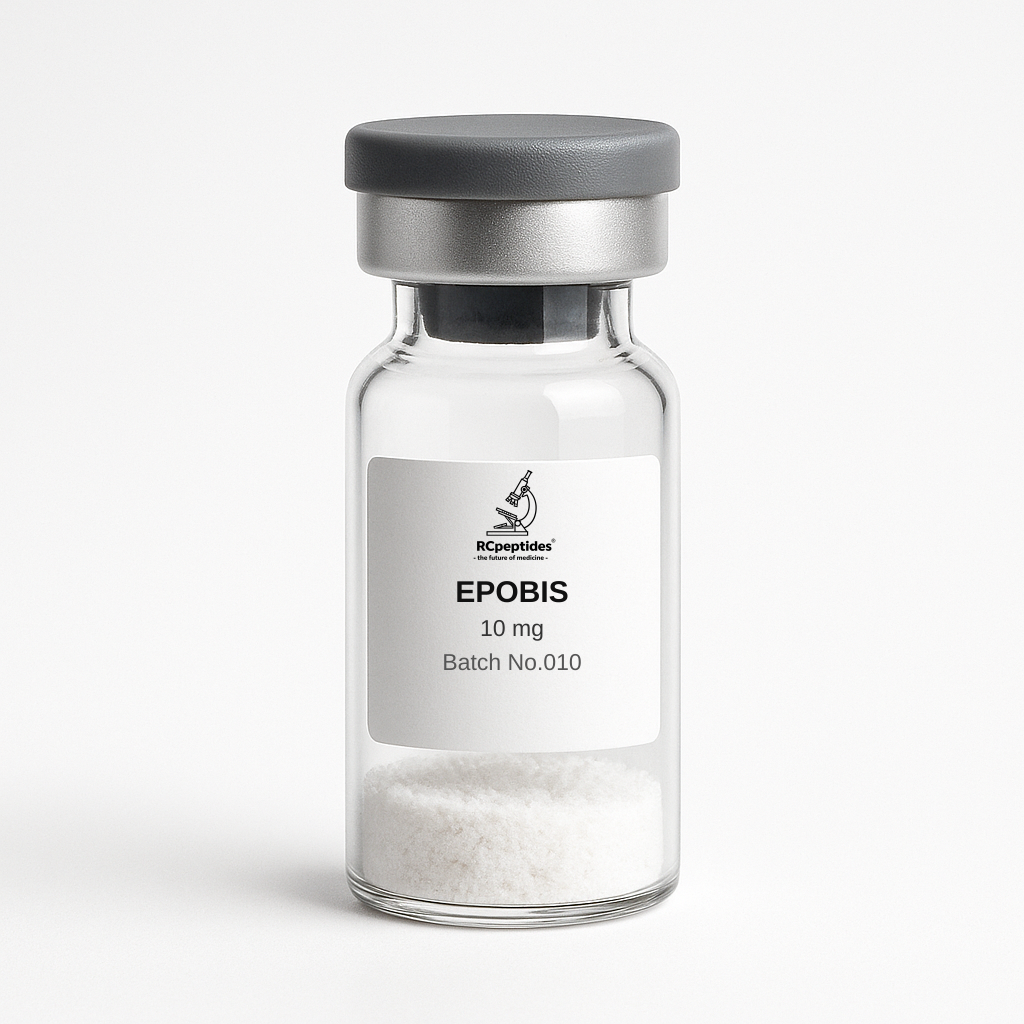
Epobis 10mg vial
Price range: €100.00 through €850.00
Epobis, 10 mg research vial. Batch No.010. Experimental EPO-derived peptide; biological evidence is preclinical.
10 mg vial · Batch No.010
Epobis: Benefits, Mechanism, Safety & Research Review
Epobis is an experimental erythropoietin receptor (EPOR) agonist peptide derived from a receptor-binding region of human erythropoietin (EPO).
Its peptide sequence is:
Asn-Glu-Asn-Ile-Thr-Val-Pro-Asp-Thr-Lys-Val-Asn-Phe-Tyr-Ala-Trp-Lys-Arg
or:
NENITVPDTKVNFYAWKR
The linear 18-amino-acid peptide is listed with CAS number 915091-83-7, molecular formula C₁₀₀H₁₅₁N₂₇O₂₉, and molecular weight approximately 2195.44 g/mol.
Importantly, the principal published Epobis experiments used a tetrameric/dendrimeric version of the peptide, designed to activate the erythropoietin receptor without producing the strong erythropoietic activity associated with EPO itself.
Preclinical studies suggest Epobis may promote neurite growth, neuronal survival, anti-inflammatory signaling and memory-related effects, while remaining nonerythropoietic under the experimental conditions studied.
1. Potential Benefits of Epobis
| Benefit | Key take-away |
|---|---|
| 1. Neuroprotection | Epobis increased neuronal survival in experimental cell models. |
| 2. Neurite growth | Promoted neuritogenesis in several primary neuronal cultures. |
| 3. EPOR activation | Specifically binds the erythropoietin receptor and activates downstream signaling. |
| 4. Anti-inflammatory activity | Reduced TNF release from activated macrophages and microglia. |
| 5. Memory research | Improved delayed social-recognition memory in rats in one preclinical study. |
| 6. Blood-brain barrier penetration | Systemically administered Epobis was detected in cerebrospinal fluid in rats. |
| 7. Neuroregeneration research | Neurite-promoting activity makes Epobis relevant to neuronal repair research. |
| 8. EAE research | Delayed clinical signs in an experimental autoimmune encephalomyelitis model. |
| 9. STAT5 signaling | EPOR activation by Epobis is associated with STAT5 signaling. |
| 10. Nonerythropoietic EPOR signaling | Produced neurobiological effects without significant hematopoietic stimulation in studied animal models. |
2. Epobis Mechanism of Action
2.1 Erythropoietin Receptor Activation
The principal mechanism of Epobis is agonism of the erythropoietin receptor (EPOR).
Erythropoietin normally activates EPOR to regulate red-blood-cell production, but EPOR is also expressed in several nonhematopoietic tissues, including the nervous system.
Epobis was designed from an EPO receptor-binding sequence and specifically binds EPOR.
Surface-plasmon-resonance experiments reported an apparent binding affinity of approximately 60 nM, while neuronal experiments showed EPOR-dependent neurite growth and survival.
A simplified model is:
Epobis → EPOR activation → intracellular signaling → neuronal survival + neurite growth + tissue-protective signaling
2.2 Proposed Downstream Biology
| Pathway | Functional outcome | Context |
|---|---|---|
| EPOR activation | Receptor signaling | Neuroprotection |
| STAT5 activation | Gene transcription | Cell survival |
| Neuritogenesis ↑ | Increased neurite growth | Neuroregeneration |
| Neuronal survival ↑ | Reduced experimental cell death | Neuroprotection |
| TNF release ↓ | Reduced inflammatory signaling | Microglia / macrophages |
| CNS exposure | Peptide detected in CSF | Brain-related research |
Epobis therefore attempts to separate the tissue-protective effects of EPO signaling from EPO’s powerful effects on red-blood-cell production.
3. Neuroprotection and Neuronal Survival
Neuroprotection is one of the strongest areas of Epobis research.
The original 2012 study found that Epobis promoted survival of hippocampal and cerebellar neurons exposed to experimental injury conditions.
It also induced neurite outgrowth in an EPOR-dependent manner.
These findings suggest that Epobis can activate neuronal survival pathways associated with erythropoietin signaling.
However, these experiments were primarily performed in cell cultures rather than humans.
4. Neuritogenesis and Neuroregeneration
Epobis has demonstrated particularly interesting effects on neurite outgrowth.
Neurites are projections from developing or regenerating neurons that can become axons or dendrites.
In experimental neuronal cultures, Epobis promoted neurite growth in:
- motoneurons,
- hippocampal neurons,
- cerebellar neurons.
The response was dose-dependent and associated with EPOR activation.
This makes Epobis scientifically interesting for research involving neuronal plasticity and neuroregeneration.
5. Anti-Inflammatory Effects
Epobis has also demonstrated anti-inflammatory activity.
In vitro experiments found that Epobis reduced tumor necrosis factor (TNF) release from activated:
- macrophages,
- primary microglia.
Microglia are the principal resident immune cells of the central nervous system.
The anti-inflammatory effect was broadly similar in direction to EPO, although Epobis was less potent under the experimental conditions.
This suggests:
Epobis → EPOR-related signaling → inflammatory cytokine modulation → reduced TNF release
6. Blood-Brain Barrier Penetration
One particularly important finding is that systemically administered Epobis was detectable in cerebrospinal fluid (CSF).
In rats, researchers reported a plasma-to-CSF ratio of approximately 20:1 two hours after systemic administration.
This provides experimental evidence that the studied Epobis preparation can reach the central nervous system.
However, this does not establish human brain bioavailability or pharmacokinetics.
7. Epobis and Memory
Epobis has also been investigated for possible effects on memory.
In rats, Epobis did not produce an immediate improvement in short-term social-recognition memory.
However, animals showed improved memory performance approximately three days after administration, suggesting a delayed or persistent neurobiological effect.
The authors interpreted this as evidence of a longer-term memory-enhancing effect.
There are currently no controlled human studies demonstrating cognitive enhancement from Epobis.
8. Epobis and Experimental Autoimmune Encephalomyelitis
Epobis has been evaluated in experimental autoimmune encephalomyelitis (EAE), a commonly used animal model for inflammatory demyelinating disease.
Systemic administration delayed the appearance of clinical disease signs.
However, Epobis did not completely prevent disease progression.
This suggests potential anti-inflammatory or neuroprotective activity rather than evidence that Epobis treats multiple sclerosis.
Human efficacy remains unknown.
9. Epobis Pharmacokinetics
The pharmacokinetics of Epobis are only partially characterized.
Available animal studies demonstrate that after systemic administration:
- Epobis is detectable in plasma,
- Epobis reaches cerebrospinal fluid,
- CNS exposure occurs within hours.
However, major parameters remain poorly defined, including:
- elimination half-life,
- Tmax,
- Cmax,
- absolute bioavailability,
- metabolic pathways,
- tissue distribution,
- human pharmacokinetics.
The existing research therefore provides evidence of CNS accessibility, but not a complete pharmacokinetic profile.
10. Epobis Safety and Tolerability
Nonerythropoietic Activity
A major objective behind Epobis development was to retain beneficial EPO-like signaling without strongly stimulating erythropoiesis.
In animal experiments, even longer-term Epobis administration did not produce the hematopoietic effects characteristic of EPO.
This is particularly important because excessive erythropoietic stimulation can increase:
- hematocrit,
- blood viscosity,
- thrombotic risk.
Important Safety Limitations
Epobis remains an experimental peptide.
Important unknowns include:
- long-term human safety,
- cardiovascular effects,
- immune effects,
- chronic EPOR activation,
- hepatic effects,
- renal effects,
- reproductive toxicity,
- pregnancy safety,
- drug interactions,
- carcinogenic potential.
No established human safety profile currently exists.
11. Epobis vs Erythropoietin (EPO)
| Feature | Epobis | Erythropoietin |
|---|---|---|
| Main target | EPOR | EPOR |
| Structure | EPO-derived peptide | Full glycoprotein hormone |
| Neuroprotective research | Yes, preclinical | Yes |
| Neuritogenesis | Yes | Yes |
| Anti-inflammatory effects | Yes, preclinical | Yes |
| Blood-brain barrier exposure | Demonstrated in animals | Limited / context-dependent |
| Erythropoietic activity | Minimal / absent in studied models | Strong |
| Human clinical evidence | None established | Extensive |
| Approved medicine | No | Yes, for specific indications |
The scientific interest in Epobis therefore comes from its attempt to produce EPOR-mediated tissue-protective signaling without strong erythropoiesis.
12. Evidence Profile
| Claim | Evidence strength |
|---|---|
| Epobis binds EPOR | Strong mechanistic evidence |
| Epobis activates EPOR-related signaling | Strong preclinical evidence |
| Epobis promotes neurite growth | Strong preclinical evidence |
| Epobis promotes neuronal survival | Strong preclinical evidence |
| Epobis reduces TNF release | Preclinical evidence |
| Epobis crosses the BBB | Animal evidence |
| Epobis improves delayed memory | Animal evidence |
| Epobis delays EAE symptoms | Animal evidence |
| Epobis lacks major erythropoietic activity | Animal evidence |
| Epobis improves cognition in humans | Unknown |
| Epobis treats neurodegenerative disease | Unknown |
| Epobis treats multiple sclerosis | Unknown |
| Long-term human safety | Unknown |
13. Regulatory and Research Status
- Name: Epobis
- Sequence: NENITVPDTKVNFYAWKR
- Length: 18 amino acids
- CAS number: 915091-83-7
- Molecular formula: C₁₀₀H₁₅₁N₂₇O₂₉
- Molecular weight: approximately 2195.44 g/mol
- Target: Erythropoietin receptor (EPOR)
- Compound class: EPO-derived experimental peptide
- Research area: Neuroprotection, neuroregeneration and inflammation
- Clinical stage: Preclinical
- Approved medicine: No
The principal academic studies used tetrameric/dendrimeric Epobis, whereas commercially listed linear Epobis corresponds to the 18-amino-acid sequence above. These preparations should not automatically be assumed to have identical biological activity.
14. Future Research
Future Epobis studies need to establish:
- full pharmacokinetics,
- biological half-life,
- human CNS penetration,
- optimal molecular format,
- monomer versus tetramer activity,
- dose-response relationships,
- receptor selectivity,
- duration of EPOR activation,
- cognitive effects,
- neuroprotective efficacy,
- inflammatory effects,
- cardiovascular safety,
- long-term toxicity,
- human safety.
Human clinical studies would be particularly important because current evidence is almost entirely cellular and animal-based.
15. Overall Evidence Assessment
Epobis is an unusual experimental neuroprotective peptide because it directly targets the erythropoietin receptor while attempting to avoid the hematopoietic effects of erythropoietin itself.
Its strongest evidence comes from mechanistic, cell-culture and animal studies.
Best-supported findings
- Epobis binds the erythropoietin receptor
- EPOR activation promotes downstream STAT5 signaling
- Epobis stimulates neurite outgrowth
- Epobis promotes neuronal survival
- Epobis reduces TNF release in inflammatory cell models
- Systemic Epobis reaches cerebrospinal fluid in rats
- Epobis delayed disease signs in an EAE animal model
- Epobis improved delayed social-recognition memory in rats
- Significant erythropoietic activity was not observed in studied animal models
Claims that remain uncertain
- Cognitive enhancement in humans
- Human neuroprotective efficacy
- Treatment of neurodegenerative disease
- Effects in multiple sclerosis
- Long-term human safety
- Optimal dose and exposure
- Human half-life
- Long-term cardiovascular safety
- Activity of linear versus dendrimeric Epobis
Overall: Epobis is an experimental nonerythropoietic erythropoietin receptor agonist with promising preclinical evidence for neuroprotection, neurite growth, inflammatory modulation and CNS activity. Its ability to activate EPOR-related tissue-protective pathways without producing strong erythropoiesis makes it mechanistically distinct from conventional erythropoietin. However, the evidence remains preclinical, and controlled human studies are required before its cognitive, neurological or therapeutic potential can be established.
| Purchase option |
Single vial ,Whole kit |
|---|
Related products
5-Amino-1-MQ 50mg vial
Price range: €60.00 through €510.00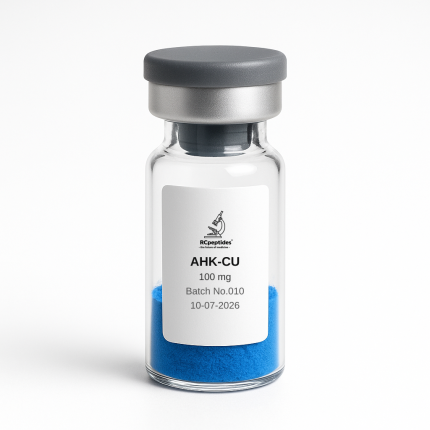
AHK-CU 100mg vial
Price range: €52.50 through €446.25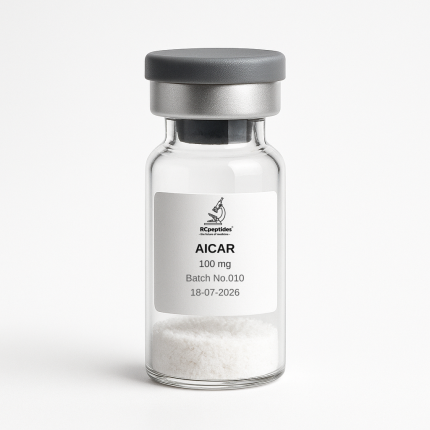
AICAR 100mg
Price range: €75.00 through €637.50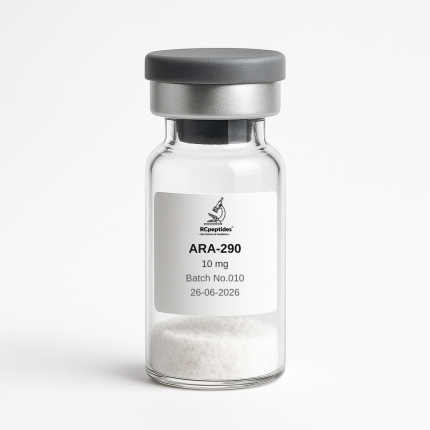
ARA290 10mg vial
Price range: €60.00 through €510.00
Tesamorelin 10mg vial
Price range: €60.00 through €510.00
Thymosin alpha-1 10mg vial
Price range: €65.00 through €552.50
Reviews
There are no reviews yet.